Contact us for help with your samples

Protect Your Brand and Your Consumers with LECO’s Advanced GCxGC-TOFMS Technology
Today’s labs are facing a new reality: chemical contaminants in food are more complex, more varied, and more difficult to detect than ever. From mineral oil hydrocarbons (MOSH/MOAH) to pesticide residues and non-intentionally added substances (NIAS) migrating from packaging, the risks are everywhere, and conventional methods aren’t keeping up.
Standard LC–GC–FID workflows provide data, but not clarity. They fall short when it comes to distinguishing between MOSH and POSH, or MOAH and natural terpenes. Worse, they overlook unknown compounds entirely, which is a serious limitation in light of EFSA guidelines, Codex MRLs, and FSMA preventive controls, which require confident identification—not just detection.
Our solutions offer deeper insights into the source of contamination and help identify potential interferences, giving you the confidence and context regulatory standards demand.
LECO’s GCxGC–TOFMS platform tackles distinct analytical challenges through specialized workflows. Two-dimensional gas chromatography with time-of-flight mass spectrometry provides the foundation, but each application requires optimized methods.
For MOSH/MOAH analysis, the system delivers accurate quantitation, removal of chromatographic interferences, achieves cleaner separation of complex hydrocarbon mixtures, and the potential to identify chemical biomarkers that trace contamination sources.
Pesticide screening and NIAS detection demand different capabilities. Our platform handles difficult food matrices that overwhelm conventional systems while maintaining full spectrum sensitivity for effective non-targeted screening workflows, catching emerging contaminants before they become regulatory problems.
Non-targeted screening complements both approaches by detecting compounds that targeted methods miss, while confirmatory analysis ensures global compliance standards. Each application uses the same core technology through distinct, purpose-built methodologies, maximizing performance for specific contamination challenges.
Whether you’re testing chocolates for mineral oil contaminants, screening spice shipments for pesticide residues, or evaluating packaging for extractables, LECO’s GC and GCxGC–TOFMS solutions turn complex detective work into routine food safety compliance testing—with clarity, confidence, and speed.
Food Safety Webinar Series
Gain Confidence in Your Results with Our Expert-Led Webinars
Tackle non-targeted screening and compliance testing for food safety like never before with our educational and informative webinars. Learn from experts in the field and discover how LECO instruments can help you achieve reliable, comprehensive results.

ON DEMAND
Advanced GCxGC–MS Strategy for Pesticide Residue Analysis in a Highly Complex Chili Pepper Matrix

ON DEMAND
What You Don’t See: Beyond Routine Analysis with
LC–GCxGC-TOFMS–FID
SPEAKER: Silvia Aguiló Losa | Group Leader for GCxGC and Product Manager for MOSH/MOAH | SGS Institut Fresnius GmbH
Food Safety Profiling Applications
Browse the app notes below to discover how our mass spectrometers perform when put to the test with your industry’s applications.

Determining MOSH/MOAH in Food with GCxGC–TOFMS

Trust Your Results in Mineral Oil Analysis

Packaging Contaminants in the Headspace of Commercially Available Cola Beverages

Determination of Pesticides in Tomato by GCxGC-TOFMS

Fast Pesticide Residue Analysis in Food with a New Benchtop GC-TOFMS: Pegasus BT

Non-Targeted Screening in Food: Boosting Food Analysis using GCxGC-TOFMS
GC×GC for Mineral Oil Hydrocarbon Analysis in Foods
Insights from the DTU National Food Institute and LECO
European regulations now mandate rigorous monitoring of mineral oil hydrocarbons (MOSH/MOAH) in foods due to potential health concerns. This EU Reference Laboratory guidance document establishes GCxGC as the gold standard technique for comprehensive MOH characterization, contamination source identification, and regulatory compliance.
Key Topics:
• Standardized GCxGC methodologies for MOSH/MOAH analysis
• Chromatogram interpretation and quantitative reproducibility
• Identifying analytical interferences and contamination sources
• Meeting EU food safety requirements
As a leader in GCxGC technology and instrumentation, LECO Corporation is the ideal partner for implementing these advanced analytical solutions. Our specialized expertise ensures laboratories have the precision tools needed for accurate, compliant MOH analysis.
Download the complete guidance document to enhance your food safety testing capabilities.

Why Choose LECO?
Beginning in 2020, LECO was first in line to offer both qualitative and quantitative MOSH/MOAH analysis in one validated workflow.

No False Positives
Separate MOSH/MOAH from natural interferences (terpenes, squalene, carotenoids, etc.) and pinpoint contamination sources.

Regulatory Confidence

Same Preparation, Improved Accuracy
Analyze samples prepared with fract/collect from any existing LC-GC-FID.

Best-in-Class Service
We dedicate ourselves to your success through unmatched support, training, and fast service.
Featured Instruments and Software
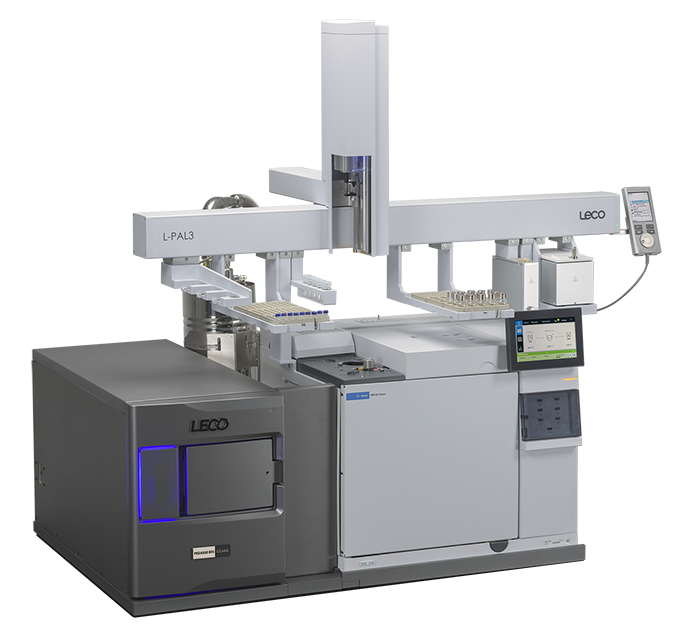
Pegasus BTX
High Sensitivity Time-of-Flight Mass Spectrometer for GC and GCxGC
Pegasus BTX4D
High-resolution GC-TOFMS with Folded Flight Path technology

ChromaTOF Sync Quantitation Tools
Improve mineral oil quantitation accuracy with this easy-to-use software solution for GCxGC-FID data.
MOSH/MOAH Analysis 2026: Why Labs Are Switching from LC-GC-FID to GCxGC-TOFMS Before EU Limits Hit
Insights from the Instituto de la Grasa and LECO

MOSH/MOAH analysis in food faces tighter EU limits by 2026 due to EFSA’s genotoxicity concerns. Traditional LC-GC-FID struggles with complex matrices and low-level MOAH quantification. Collaboration between Instituto de la Grasa (CSIC) and LECO shows GCxGC-TOFMS/FID with parallel detection resolves the MOSH hump, separates biogenic interferences, and reliably quantifies MOAH below 10 µg/kg. Automation and advanced software further improve accuracy and throughput.
Read how GCxGC-based methods are becoming essential for regulatory compliance and future-proofing labs.
Testimonials
“We at SGS MOSH/MOAH group are using the GCxGC-TOFMS from LECO to separate the highly complex fractions of MOSH/MOAH contaminates in food. When you want to identify special patterns of contamination species amongst other analytics (e. g carotenoids) you need a high separation power in combination with a fast screening MS. This is provided by the LECO TOF. Actually we have a new project together with LECO and another company to quantify MOSH/MOAH fractions. The complexity of the instrumentation is high, but with the support of the application team from LECO we reach our goals.”
 “We at SGS MOSH/MOAH group are using the GCxGC-TOFMS from LECO to separate the highly complex fractions of MOSH/MOAH contaminates in food. When you want to identify special patterns of contamination species amongst other analytics (e. g carotenoids) you need a high separation power in combination with a fast screening MS. This is provided by the LECO TOF. Actually we have a new project together with LECO and another company to quantify MOSH/MOAH fractions. The complexity of the instrumentation is high, but with the support of the application team from LECO we reach our goals.”
Silvia Aguilo Losa | Product Manager and Group Leader GCxGC Mineral Oils Analysis en SGS Institut Fresenius GmbH
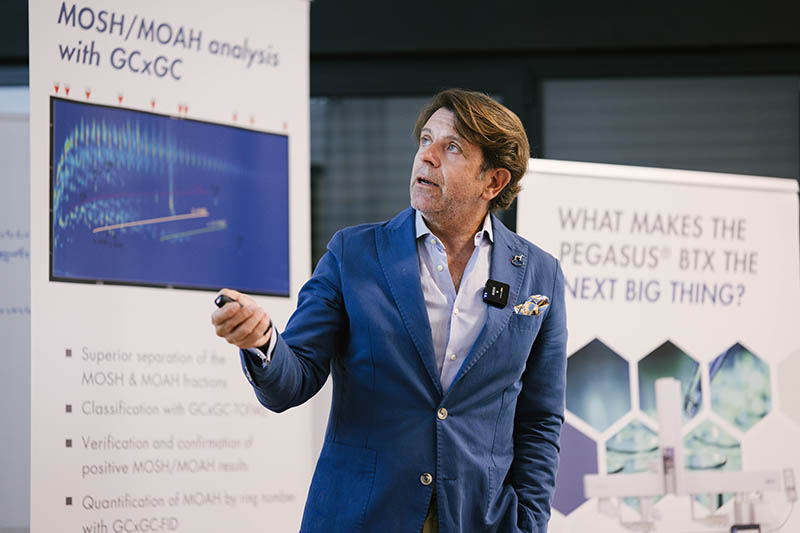
“LECO’s GCxGC-TOFMS/FID system gives us the certainty we need. It eliminates coeluting and biogenic interferences, allowing us to confidently quantify what’s really in the sample. That confirmation is critical — especially when contamination levels are close to the LOQ and the margin of error is so narrow.”
Prof. Wenceslao Moreda, Instituto de la Grasa (CSIC)