
Published on
Pushing the Boundaries of Chemical Forensics: Dr. Kate Perrault Uptmor’s Research at William & Mary
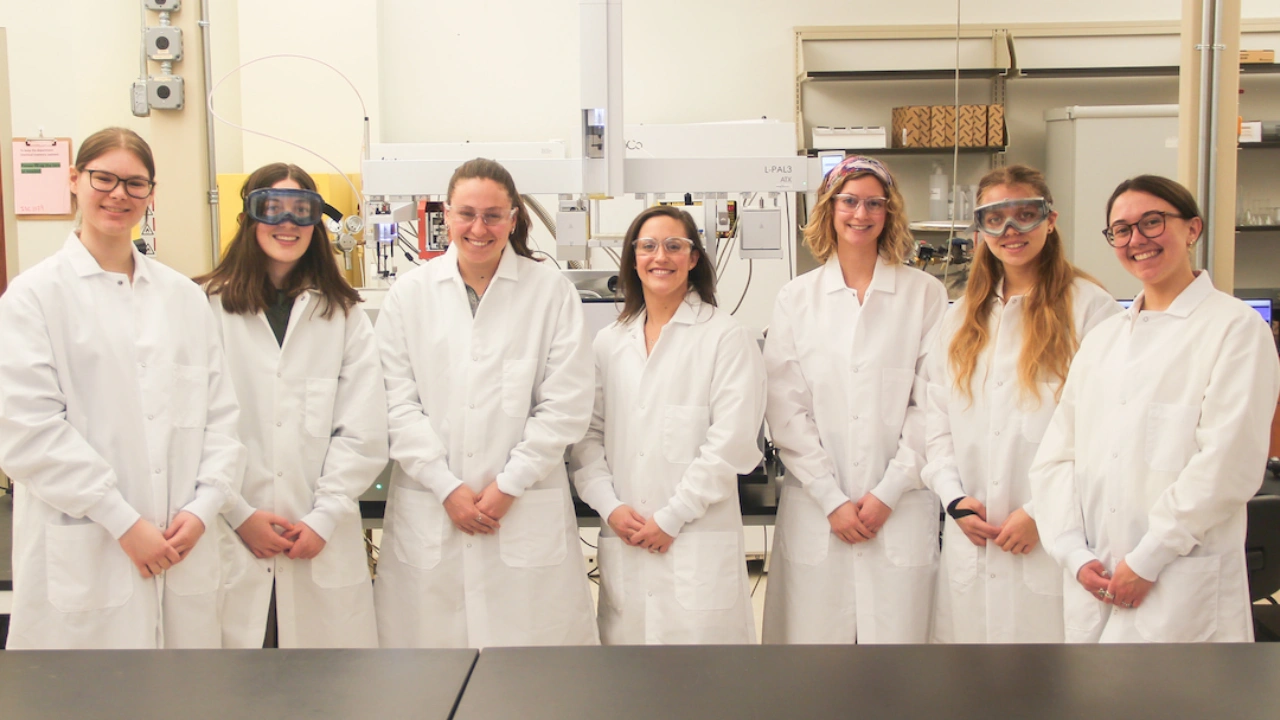
At LECO, our goal is to empower laboratories doing truly vital work with innovative tools, partnering with them to solve complex chemistry problems. One of our key academic collaborations is with Dr. Kate Perrault Uptmor, Assistant Professor of Chemistry at William & Mary in Williamsburg, Virginia. By pairing her lab’s groundbreaking research in chemical forensics with LECO’s Pegasus BTX 4D and Paradigm Flow Modulator, this partnership pushes the boundaries of non-targeted analysis for highly complex samples.
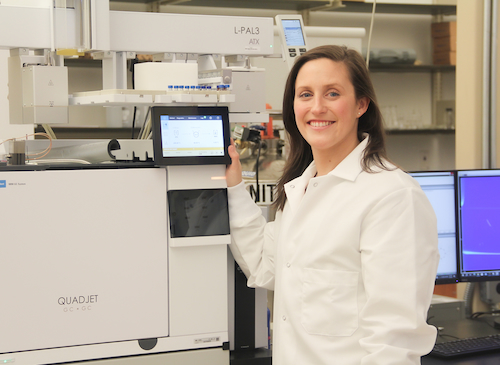
Dr. Perrault Uptmor’s laboratory is fundamentally concerned with untangling intricate chemical profiles related to life, health, disease, and death. Her team’s specialized focus requires extreme peak capacity and sensitivity to pull meaningful data from highly challenging matrices.
Decoding the Chemistry of Forensics and Biosensors
Current projects in Dr. Perrault Uptmor’s research group span critical security, forensic science, and recovery applications, including:
- Organic Gunshot Residue Profiling: Mapping out the complex chemical signatures left behind in firearms investigations to improve evidence characterization.
- Fingerprint Residue Characterization: Investigating the volatile and semi-volatile compounds in latent prints to extract deeper investigative insights.
- Microbial Forensic Analysis of Decomposing Remains: Studying the specific chemical markers of decomposition to aid in search, recovery, and mass disaster applications.
- Scent-Detection Canine Benchmarking: Utilizing comprehensive two-dimensional gas chromatography with time-of-flight mass spectrometry (GCxGC-TOFMS) to improve our understanding of how service canines act as biological sensors in operational environments.
Moving Toward Greener Analytical Approaches
Beyond forensic applications, the lab is actively addressing the future of chromatography itself. Dr. Perrault Uptmor’s team is working on translational studies comparing helium and hydrogen carrier gases. This research provides the analytical community with a clearer roadmap for adopting hydrogen as a sustainable, greener alternative without sacrificing separation power.
Additionally, the lab is developing post-processing machine learning strategies to streamline the handling of large batch and longitudinal GCxGC datasets, making multi-dimensional data more accessible and actionable.
Why the Pegasus BTX 4D Fits the Mission
Analyzing these types of complex environmental and forensic mixtures requires state-of-the-art multi-dimensional separation.
“LECO’s Pegasus BTX 4D with Paradigm Flow Modulator is a great fit for the kind of work Dr. Perrault Uptmor is doing in her lab,” says John Hayes, Separation Science Product Manager. The combination of high-performance TOFMS with robust, consumables-free modulation provides the lab with the precise tools required to map out heavily congested sample profiles with absolute confidence.
Through collaborations like this, researchers gain deeper integration with a comprehensive support network. “Our partners gain much more than advanced instrumentation—they also get direct access to LECO’s global support network,” says Farai Rukunda, Director of Separation Science Customer Success. “This includes working alongside leaders in the field of GCxGC technology, software development, method development, and complex applications.”
LECO is incredibly proud to support Dr. Perrault Uptmor and her team as they continue to uncover critical insights and train the next generation of separation scientists.


 English
  Spanish
  German
  French
  Portuguese