Easter, a holiday celebrated in many countries around the world, is nearly here! In the United States, Easter baskets are often given to children on the holiday, filled with lots of candy and treats. One treat in particular you’re sure to find is jelly beans.
Jelly beans are a popular Easter candy in the US due to their shape closely resembling eggs, their bright, spring-time colors, and their quaint size that allows them to fit perfectly inside plastic eggs used for egg hunts. But how do parents know they can trust those jelly beans are safe for their children to eat? And can they be sure they taste like they are supposed to?
Food Manufacturers Can Ensure Safety and Integrity with GC-TOFMS
It’s up to the manufacturer to make sure the foods they produce are up to safety guidelines. Advanced instrumentation, like LECO’s Pegasus BTX, can provide the data needed to make those quality determinations.
The BTX is a high-sensitivity benchtop GC–TOFMS (gas chromatography–time-of-flight mass spectrometer) purpose-built for comprehensive volatile and semi-volatile analysis – making it ideal for food, flavor, and aroma applications. It enables full-spectrum, non-targeted detection of aroma compounds with femtogram-level sensitivity, uncovering trace chemicals that define flavors and odors. In practical terms, the BTX excels at profiling complex flavor mixtures (e.g. spices, beverages, essential oils), comparing aroma profiles across products or batches, and detecting minute off-flavors or contaminants that impact quality. Its fast acquisition (up to 500 spectra/sec) and optional GC×GC capability allow it to separate and identify co-eluting aroma components that traditional one-dimensional GC-MS might miss.
So, not only is it a powerful tool for quality control, but it can also tell manufacturers if their product is hitting the mark in terms of intended taste and smell. It can also tell them if the ingredients they source are the real deal, or potentially not as “pure” or “high-end” as they claim to be.
Accurate and Comprehensive Taste-Testing
With jelly beans, producers often offer a variety of flavors. How can they make sure they got those flavors just right? The BTX is the ultimate taste-tester. When analyzing a sample with the BTX, users can expect a collection of full mass spectra, so no compounds go unnoticed. Analysts can identify known flavor compounds and also discover unknowns in the same run. When used in conjunction with advanced data analysis tools like LECO’s ChromaTOF software, it’s simple to find data points of interest. A complete profile of the flavors and aromas inside the jelly bean is available to be explored. Analysts can also compare multiple samples and easily see their similarities and differences, which can be helpful for both flavor differentiation and detection of unwanted compounds.
See it For Yourself
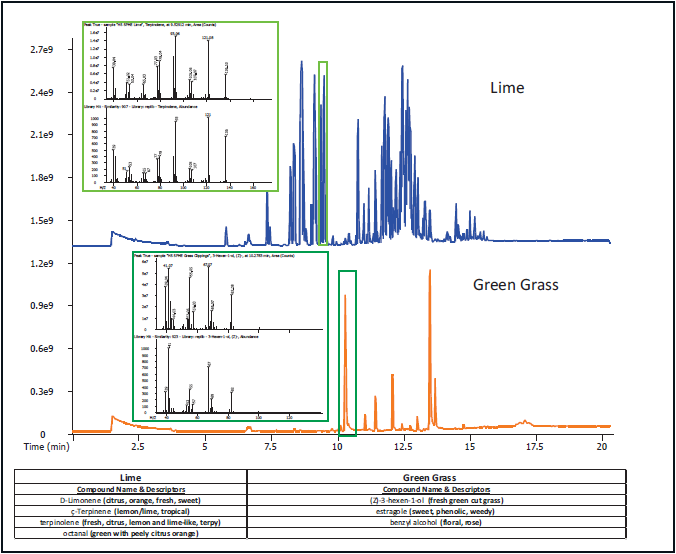
To see this firsthand, you can read about how LECO used a Pegasus BT to analyze “good-flavored” and “bad-flavored” jelly beans. The instrument revealed chemical compounds within two jelly beans that looked identical, but tasted very different. This app note, while meant to be a fun experiment, highlights the importance of food testing—just because something “looks good,” doesn’t mean it is. It might even smell good! But there is so much lying within to be discovered, and LECO instruments have the ability to reveal it all.