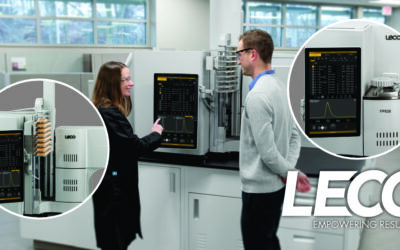
Thermogravimetric analysis (TGA) first started in the early 20th century, and while the technology has advanced, the basic principles remain the same. With TGA, the rate of change of reactions in the chemical and physical properties of materials as functions of temperature or time is what is used to assess the properties of the sample materials. Most TGA these days is done with either micro TGAs (using milligram-size samples) or macro TGAs (using gram-size samples).
LECO’s TGA801 is a macro TGA, capable of running up to 19 samples simultaneously. This is a large advantage over the typical micro TGA, which can only handle single samples due to their required small sizes. Micro TGAs must heat and cool very quickly, with extremely precise measured accuracy of their heating rates. Small furnaces are easier to control and monitor, which means the sample size must be small. A macro TGA, on the other hand, has a much larger furnace size and can handle much larger samples. Larger samples means that sample inhomogeneity is less of a problem. More samples can be run at the same time in a macro TGA, and the results are accurate on the first run. Samples in a macro TGA do not need to be run multiple times and averaged as they often are with micro TGAs.
As instruments become more established in labs, standards are created by groups such as ASTM. Rigorous “ruggedness testing” collects data from a minimum of six samples analyzed by a minimum of six laboratories to demonstrate the precision of the developing technology. As the standards are developed, the instruments become more popular in laboratories, which enables further standards to be developed and revised to accommodate the technology.
To learn more about the differences between macro and micro TGA and how these instruments and standards work, you can order Macro Thermogravimetric Analyzers: Versatile and Underutilized Analytical Instruments from ASTM.