
Veröffentlicht am
Forensik im echten Leben: WHOI-Experten über die Macht der nicht-gerichteten Umweltanalytik
Wir hatten kürzlich die Gelegenheit, mit dem Emeritus Research Scholar Bob Nelson und dem Senior Scientist Chris Reddy von Woods Hole Oceanographic Institution (WHOI) Über ihre Arbeit am Massentransport-Deponien-Standort Palos Verdes. Chris und Bob sammelten Proben und verwendeten die LECO‚s‘-Technik. Pegasus GC-HRT 4D um herauszufinden, was genau aus den Hunderten von Fässern auf den Meeresgrund gelangte.
Wir laden Sie ein, zuzuhören und zu lesen, um zu erfahren, wie sie auf einige unserer schwierigsten Fragen geantwortet haben.
Interview Navigation
- Einleitung mit Chris Reddy und Bob Nelson
- Tiefsee-Untersuchungen
- Warum nutzt WHOI GCxGC-Analysen?
- Unerwartete GCxGC-Ergebnisse: DDT-Verbindungen
- Die Daten durchsuchen
- Tieferes Erkunden von Umweltgiften
- Was können wir von dem erwarten? Unsauberer Abfallentsorgung Webinar?
Einleitung mit Chris Reddy und Bob Nelson
Julie: Ich werde mit dieser ersten Frage ein bisschen außerhalb des Rahmens gehen, weil es mein erstes Mal ist, dass ich euch kennenlerne. Und ich würde mich sehr freuen, ein bisschen mehr über euch zu erfahren: wer ihr seid, wie ihr dahin gekommen seid, wo ihr jetzt seid, und ja, einfach ein bisschen mehr über euch zu erfahren.
Chris Reddy: Geh du zuerst, Bob.
Bob Nelson: Ich bin 1987 tatsächlich in der WHOI angekommen.
Julie: Oh, wow.
Bob: Also, ich bin ein alter Hase. Ja. Und seitdem bin ich in der Chemiefachstelle tätig.
Julie: Super.
Chris: Erkläre die Umstellung. Ich meine, du weißt schon, wie du es tust und dann wechselst du.
Bob: Ja, ich habe an der University of Connecticut medizinische Forschung durchgeführt und schließlich beschlossen, dass ich das Opfern von Tieren nicht mögen würde. Daraufhin habe ich mich für die Umweltwissenschaften entschieden.
Julie: Das ist großartig. Ich glaube, das wäre wahrscheinlich auch das, was ich getan hätte.
Chris: Ich werde hier mehr von Bob haben. Also ich bin Chris Reddy. Ich kam zur WHOI – und die Aussprache lautet “hoo-ey”, Woods Hole Oceanographic Institution – ich kam hier im Dezember 1997, also war ich erst im Freiheitsentzug (lacht), denn wenn Leute hierher kommen, gehen sie nicht weg. Und so hat Bob offiziell in den Ruhestand getreten, aber er arbeitet immer noch. Das war im Juni 2021 oder Juni 2022?
Bob: ‘22
Chris: Juni 2022.
Also bin ich ein leitender Wissenschaftler, was so ähnlich ist wie ein ordentlicher Professor, und leite seit 2000 ein Forschungsprogramm mit Bob. Also habe ich 2000 angefangen, und 2002 hatte ich viel Forschungsgeldern in den Händen. Einige davon waren für die Anschaffung von GCxGCs bestimmt.
Und so hatte ich meinen ersten erhalten, aber er war nicht LECO– obwohl ich LECO den übrigens kaufen wollte –, aber das ist eine andere Geschichte. Der erste – eigentlich, nein, ich wollte Ihre LECO Massenbestimmung kaufen – aber ich wurde abgewiesen. Wir haben stattdessen diesen Finnegan gekauft, der besser als Anker verwendet worden wäre. Aber das ist eine andere Geschichte.
Es war so – ich hatte eine Menge Geld. Ich besaß ein brandneues GCxGC, und ich hatte keine Zeit, die Tasten zu drücken. Und zu dieser Zeit arbeitete Bob für einen anderen Mann, der Geld knapp hatte. Ich glaube, Bob hatte langsam die Geduld verloren, mit diesem Mann zu arbeiten. Und ich konnte nicht – ich hatte das Geld, zwei Postdocs einzustellen, und ich konnte keine Postdocs bekommen, die mir gefallen. Also sprach ich mit meinem Nachbarn/dem Laborkollegen/dem Mentor. Er sagte: Du solltest das Geld zusammenlegen und Bob einstellen. Das wäre das Beste, was passieren könnte. Und wir taten es. Und es hat funktioniert. Seitdem sind wir ein Team.
Julie:Das ist eine tolle Geschichte.
Chris: Ja, ja. Und so sind wir zusammen die Welt bereist und Proben von Menschen gesammelt. Alle Schichten der Gesellschaft haben wir kennengelernt; mit allen Schichten zusammengearbeitet; an jedem verrückten Beispiel haben wir eine verrückte Geschichte entdeckt – egal, ob es sich um Öl aus dem Meeresboden, Öl aus Smurf-Blut oder Klagen wegen gefälschten Heizöls handelt –, und wenn wir darüber nachdenken, könnten wir ewig darüber reden – und das gilt für fast jeden großen Ölverschmutzungsfall, der in den letzten 20 Jahren stattgefunden hat.
Bob:Die einzige Kontinente, die wir noch nicht besucht haben, sind die Antarktis.
Chris: Ja. Und wir haben Feldproben – wir erhalten ständig Feldproben. In den letzten drei Tagen – also in der letzten Woche – haben wir gerade zwei Proben von Öl erhalten, die aus japanischen Wracks aus dem Zweiten Weltkrieg auf den Salomoninseln austreten.
Und nächste Woche bekomme ich eine Probe von einem Wrack aus dem Zweiten Weltkrieg vor der Küste von Cape Cod. Letzte Woche haben wir – und wir werden das am Freitag mit Joe besprechen – unsere erste veröffentlichte Studie über das Öl aus der USS erhalten. Arizona in Pearl Harbor. Wir sehen also viele Dinge. Und wir nutzen diese – wir sind in der Branche, die es uns an die Hand gibt, Geschichten darüber zu erzählen, was passiert, wenn man eine Chemikalie in die Umwelt wirft.
Ich weiß nicht viel über Giftstofftoxikologie. Bob hat mehr biologische Grundlagen als ich. Für uns bedeutet das, dass man, wenn man eine Chemikalie in die Umwelt bringt, im Grunde die Natur auf eine Laufbandanlage setzt. Wir stören die Natur und versuchen zu verstehen, wie sie darauf reagiert, weißt du?
Welche Mechanismen nutzt die Natur, um einen Schadstoff zu überwinden oder nicht? Und der Wert liegt in der kurzfristigen Situation: Wenn es einen Ölverschleppung gibt, können wir durch die schnelle Analyse der Proben Wissen liefern und den Einsatzkräften einen Einblick verschaffen. Wir können auch während eines Ölverschleppungsszenarios Einblicke darüber geben, wie man ungewöhnliche Verschmutzungen forensisch identifiziert und sicherstellt, dass die verantwortliche Person, der Verschmutzer, die entsprechende Strafe für das getanene zahlt.
Aber wir nutzen diese Erkenntnisse auch, weil, wenn man eine Plastikartikulation der nächsten Generation entwirft und aus Ölspuren weiß, dass bestimmte Chemikalien eine bestimmte Struktur haben, möchte man diese Struktur nicht – denken Sie daran wie ein großes Lego-Stück, richtig? Jedes Molekül ist ein Lego-Stück. Es gibt Teile, die sich in der Umwelt nicht abbrechen. Und dann gibt es Teile, die als Achillesferse dienen, um sich abzubrennen. Und wir versuchen immer wieder Menschen zu sagen: “Sehen Sie, wenn Sie eine Chemikalie für die nächste Generation entwickeln und sie sehr schnell abbauen möchten, dann müssen Sie sicherstellen, dass sie irgendwo eine Stelle hat, an der Sie diese Achillesferse bauen können.” Und wir basieren diese Argumente auf Studien.
Wir haben in den letzten 20 Jahren LECO Plattformen als unser Arbeitsmittel genutzt. Also erzählen wir Geschichten mit den LECO Plattformen. Wenn wir Bücher schreiben, sind die LECO Plattformen unsere Inspiration und unsere Schreibmaschine, richtig? Sie bieten uns die Möglichkeit, eine Geschichte zu erzählen. Wir sind also keine analytischen Chemiker. Wir sind nicht – zum Beispiel, als ich letzten Monat auf der ACS-Tagung war, sprechen viele analytische Chemiker darüber – und das trifft sie in keiner Weise an – sie sprechen darüber, wie sie die absolute perfekte Separation optimieren und wie wir das erreichen können, damit Sie die schnellstmögliche Abwicklung und das beste Signal-Rauschverhältnis erhalten.
Und obwohl Bob wirklich hervorragende Messungen durchgeführt hat, sind wir nicht daran interessiert, das “perfekte, perfekte, perfekte” Ergebnis zu erzielen. Unser Ziel ist es, die LECO Plattform zu nutzen, um eine Geschichte zu erzählen, die kein anderes Instrument leisten kann. Und das tun wir seit 20 Jahren ohne jeden Zweifel.
Bob: Eine interessante Sache an Arizona Sie hatten die Tanks tatsächlich am Tag vor dem Untergang aufgefüllt. Also sank das Schiff mit vollen Tanks, weshalb es nun auch weiterhin leckt. Das leckt bis heute noch.
Julie: Wow. Yeah, you guys definitely do some awesome work. And I’m happy to be talking to you guys today. I’m thrilled that LECO works with you guys.
Chris: LECO has been incredibly generous. So, we have no complaints. We’re super lucky.
Julie: That’s wonderful to hear.
Bob: I’ve actually worn a path between Woods Hole and St. Joe. I’ve been to St. Joe quite a few times.
Chris: I went to St. Joe the first time–it was either it was in 2002 or 2001–and that’s when the GCxGC facility was in a bank, like near the campus. And that’s when, Mr. Warren, whenever there was a guest, he always showed up. He knew what–he knew the pulse of that place.
Bob: And he used to send us home with chocolate–a box of chocolate for your wife.
Julie: All right, heck yeah!
Chris: I can’t remember who our host was in 2001 or 2002, whenever we went out to St. Joe first time. The guy who was kind of the lead, he said, “you know, just a heads up, Mr. Warren will be by this morning.” And I was like, “Oh, you know, he’s talked to his assistant” or whatever. And he goes, “no, Mr. Warren knows everything that goes on in this. And if there was a guest on campus, he will be here.” And, you know, that was it. 15 minutes later, he came. It was very gracious, but it was kind of charming. And, arguably one of the reasons why LECO has stayed, you know, relatively a family business is, they do to that type of personal contact.
Julie: Exactly. Well, we’re super appreciative for you guys–I’m super appreciative for you guys sitting down to do this interview today.
Chris:Oh, it’s not problem.
Julie: I’ll hop into it now. Thank you for giving me some background. That’s helpful for me and awesome to know more about you guys.
Tiefsee-Untersuchungen [09:04]
Julie: The first question that I’ve got here–why don’t you guys tell me what were some of the biggest challenges in investigating the dump site, which was, what–nearly 900 meters underwater?
Chris: Yeah, so I’m gonna lead off on this question because we were on a research cruise in 2011—now, you hear cruise you think Captain Stubings and the Love Boat—but, you eat well, but you’re working like a dog.
And we were funded to study where these natural oil seeps–you know, somewhere around the world, there’s cracks in the bottom of the seafloor where oil reservoirs leak. And they’re called natural seeps—you know, if you like the Beverly Hillbillies, Jed got rich; Jed Clampett found the natural seep, and then they eventually drove oil and that’s how Jed got rich. And if you ever heard about La Brea Tar Pits in Los Angeles, that’s a natural oil seep.
Anyway, we were studying natural oil seeps off to Santa Barbara and have done some really nice work with LECO platforms. But we had an opportunity to go south, or east I guess, to off the coast of Los Angeles, on this research vessel, the Atlantis. We had an unbelievable opportunity to look for these dumped waste materials that our buddy Dave Valentine had been reading about. And the reason why we were super lucky was that on this research vessel, we had two robots, both of them unmanned. And one of them is called Sentry. And you can think about these two robots as kind of hunter-gatherers.
And so Dave had an idea where they were. And we programmed this vehicle called Sentry. We threw it over the side and it’s completely autonomous. You just give it a mission and then it goes all by itself. And we told it to go map: take some pictures, but also some sonar.
Bob: It’s equipped with an echo sounder, sonar.
Chris: So we told it to go in the middle of the night, go find it. It comes back out of the water. We download the data. And sure enough, there’s a map. And you can see all these little blips on the seafloor, [they] were definitely unusual. And so then we went to gathering stage and we used a vehicle called Jason.
And Jason is a much beefier instrument, and it even has two robotic arms, so it can collect samples. But Jason is tethered to the ship. It needs electricity to work. So whereas Sentry’s kind of a light and nimble, little search vehicle that’s scanning and looking, Jason has to do the heavy work.
The reason why these samples had not been collected in the past is that no brute and elegance had ever come to bear to look for them like we had on the research vessel Atlantis with Sentry to map the area. The thing you have to remember is that Jason can only move like a couple knots, like a couple miles an hour, so you can’t throw Jason over the side and say “let’s go find it,” because, you know–it’s like asking my toddler to go find our car keys in the baseball field, like he just never would freaking find it, right? But Sentry’s faster and Sentry can map bigger areas.
The long and the short of it is: the hard part was overcome by the outstanding technology that was available to us. The most memorable part was that we knew where it was, right? Jason has–because it has a tether–it has a lot of electricity. And a lot of electricity gives you a lot of lights, because the bottom of the seafloor is dark, and that gives you really beautiful camera images. We were in the container that Jason comes with. There’s three people in the front. There’s a pilot, there’s an engineer, and there’s a navigator. And they’re sitting in the very low-tech Star Trek–type array, and they’re going, “All right, we’re going to start seeing, based on Sentry’s map, we’re going to start seeing the dumped material.”
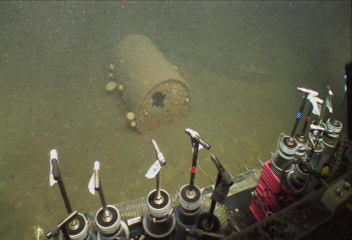
And so we can see the video on one screen of actually the bottom of the sea floor, but we can also see the map, the forward-looking radar and we can say oh my god “they’re coming, they’re coming.” And then, suddenly out of the bottom of the sea floor are all these you know metal 55 gallon drum tanks that are in a variety–you know, leaking stuff out and buried out,and you know it was you know one of these moments in life; “oh my gosh.”
This was not planned! We went out there to collect oil from the bottom of the seafloor. And, you know, what happens next is two things that have happened 50 times in my career. The first part is I talked to Dave, who’s standing next to me. He’s the chief scientist. And I’m like, “Dave, we have to collect as many samples as possible,” because we didn’t have a lot of time, because it wasn’t part of the mission. But we were like, “we have to collect as many samples as possible.” So we had to divert, put Jason on the ground, use this robotic arm.
Now that’s part one of the Chris and Bob story. The part two is me calling Bob or emailing Bob going, “You’re going to get ready. We’re going to be sending these. I’m going to mail these samples the second we get off the boat because they are so unbelievable.” And that’s what happened. You know, we can talk more about what we found. The most memorable part, the coolest part was that we were lucky enough to have the same type of analytical muscle instrumentation on the front end to find the samples as we were to interrogate the samples with a LECO platform. So, we were buttressed by high-end technology.
Julie: Yeah, that’s incredible. Because, yeah, how else are you going to be able to look at what’s on the seafloor with all the pressure?
Chris: And on top of that, we had the guy on the boat. He’s an engineer. If you lost something in the ocean, he’s the guy who finds it. He actually, for all practical purposes, he’s the one who found the Titanic. So it was–we had good people, and the right technology, the right time, and the right place. And we found this unbelievable find.
Julie: Sounds like, yeah, it was definitely right place, right time.
Chris: Yeah, no doubt. But, you know, in some respects though, to give our buddy Dave Valentine credit, he is a curious guy and he had read about this. And, you know, he was like, “hey, we have a little gap in our schedule. We should go look.” You know, a lot of other lead scientists might not have wanted to leave the site and all that stuff. He also was able to get the whole team together to do it, so there’s a lot of great leadership there as well.
So the samples get were collected with a like think of it as a pipe–a clear pipe like you get a Home Depot–and the robot pushes the sample the pipe into the ground and then picks it back up and now you have a four inch diameter pipe that’s, you know, probably–I don’t know–12 or 14 inches of mud collected. And that mud, the bottom of the seafloor, is just kind of like a tree ring, you know, that the deeper the mud, the older it gets, right?
And usually we process the samples on the deck. So the boat comes up, we take the core, we actually take kind of–think of it as kind of a plunger. We push the stuff out from the bottom and then the little cakes of the mud are coming out. And then, you know, we literally slice it with a kitchen knife and you end up getting pucks about anywhere from sometimes one to two centimeters, put them in a jar.
So now you have discrete samples collected at one location, you know, at maybe four or five depths, that we can, that we also can actually date, say, “oh, this was roughly 1965, 1975.” Those go in a jar and they’re sampled on the deck. I actually, I was part of the sampling team. I was all over that. And then we put it in a jar and it gets frozen. And then, you know, we shipped them right back to Bob once we get off the boat.
And we ended up going going back in 2013. The paper first paper didn’t get published in 2019 for a variety of reasons: time, money, yada, yada, yada. But the samples came back, and your next two questions are really more on the analysis. My job ends, you know, I just write email, the jar and the sample goes to Bob and I go, “Bob, let’s make some, tell us a story.”
Julie: So you’re kind of, you’re the man in charge now, huh, Bob?
Bob: Oh yeah, for sure.
Warum nutzt WHOI GCxGC-Analysen? [17:27]
Julie: All right, so that leads to the next question then. Analytically speaking, what are the greatest challenges that you encountered in the project and how did you address them?
Bob: The challenge is: it’s a total unknown. I mean, we had a suspicion that there were pesticides. We like to cast a really, really broad net, which is why we use the GCxGC platform. Because it turns out to be, you know, there was targeted–we did have some targeted compounds, but we also didn’t know what else was in there.
So it’s generally almost always it’s a non-targeted approach that we take because we like to see as much as we can, which is why we run very long, very slow gradients . We use very long first dimension column, et cetera. So that challenge, you know, the challenge is: what the heck is in here? And how do we, how do we figure out what’s there?
Chris: We also didn’t know what was in there.
Bob: There was medical waste and possibly in some there was, you know, there was—
Chris: Radioactive material was found in some of these things. So, you know, there’s a certain sense of uncertainty. You have to take a lot–you have to be really careful.
Bob: “Are we bringing up explosives?”
Chris: Yeah, all very possible. All entirely possible.
But we expected to see DDT and those types of chemicals because they were downstream from one of the biggest manufacturers of DDT in the United States, Montrose. But another one that has happened a thousand times between Bob and me is that: I know Bob’s running the sample and then I wait like an hour so I don’t annoy him. And then I go, “what’s it look like?”, right?
And, you know: a watched chromatograph does not separate.
We’re looking at it together and you go, “there’s a lot more oil in this.” The DDT gets the top billing, but most of the chemical in those extracts that were analyzed by LECO, are petroleum hydrocarbons.
It’s not–it’s just that DDT… Rachel Carson wrote about DDT. She didn’t write about oil. And that’s not surprising since–if you’ve ever been on The 5 in the Los Angeles area–there’s all these oil refineries. So it doesn’t surprise at all, that kind of makes sense.
Unerwartete GCxGC-Ergebnisse: DDT-Verbindungen [20:02]
Julie: That kind of leads into my next question, which was, if you could share an example of something unexpected that GCxGC revealed in your samples.
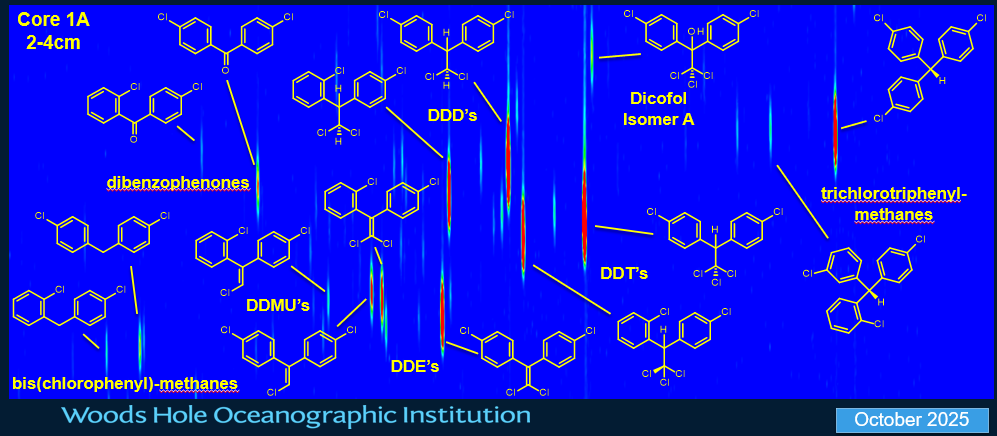
Bob: Sure. So we did find all kinds of petroleum biomarkers, like the hopanoids and steranes and compounds like that. We also found these linear alkylated benzene detergents that–I actually first saw those from a colleague of ours from our department back in the early 1990s. He was looking at Deep Water Dump Site 106 off of New York, and he found all these industrial detergents.
And we saw some of those in the sediment cores. We also saw in some of the later cores that were not in that paper, we actually found compounds that contain nitrogen, anilines—which we are assuming now that are one of the starting compounds for DDT–the DDT synthesis process. It’s a potpourri of all kinds of interesting things that we weren’t expecting to see.
Chris: Yeah, I mean, and this is where the LECO platforms come in, in that: if these samples–and they were–analyzed by 1D, GC-FID and GC-MS, you would get some interesting outcomes. You would have seen the DDT and stuff like that.
But you have to remember that when Montrose sold their product when they sold DDT to everybody, right, it wasn’t just one single molecule. It wasn’t just DDT. Like, if you buy an individual chemical from Aldrich, when you buy a chemical, you expect to get it to be 99% or something like that. But the DDT that was released and used as a pesticide in the United States was what we would call “technical grade,” and it was about 60% DDT. The rest of the 35% or so was a variety of different byproducts, incomplete products, and a range of other chemicals. So when we talk about DDT, it’s not a single entity. It’s the outcome of this reaction where they didn’t do a good job cleaning it up.
Plus, that waste might have had stuff that was left over in some reaction, it could have been otherwise. The end result, I can’t remember the number was, is that any self-respecting chemist with a benchtop GC-MS could have identified DDT, and there’s another compound called DDE, and there’s another one called DDD–totally no problem.
It’s all the rest of these compounds that were associated with DDT, that that’s where we were able to pluck them out of these complex mixtures with the HRT, with the high-res mass spec. And we went one step further–Bob went one step further. And Bob created in this paper–and this paper is one of my favorite ones of all time because we have “sloppy” in the title. Uh, if you haven’t gotten the paper—
Bob: Do you have it?
Chris: “Chemical dumping was a sloppy process.” It’s free–but we’ll send you the paper–but in the supplemental information, one of the really important points was, is that Bob went and created a library of all the different halogenated, chlorinated compounds related to DDT and put in their high-res mass spec in the back of the–basically the end of the paper, kind of the appendix–and then ranked how he identified them. You know, it’s two parts.
If I was going to list, maybe the top 10 things that, in terms of informative work that I’ve done in my career, those two files, and the supplementary information that’s all about the returns of the GCxGC-HRT are that, those two.
Bob: Basically, it’s a confidence level of how confident are we in our assignments. We show our high-res spectra versus the NIST library spectra as well . So you can compare and contrast what we got versus the NIST. They’re all really good fits actually. Except, for we got four digits past the whole unit resolution. We have a lot more confidence in our assignments because of our ability to use the mass defect that you can’t really use on a regular mass spectrum that only does whole unit resolution.
Julie: Super.
Chris: And the other thing is that, remember I was talking about the layers, right?
Julie: Yeah.
Chris: What’s interesting is that, we got different GCxGC chromatograms at different depths, right? And so it’s not only that; and the different cores had that. So we’re not only asking the LECO platforms–and they delivered–to tell a story about one singular sample at that dump site. We’re asking it to help us tell a story and interrogate the contents of one core at five or six different horizons, and the contents of another core with five or six different horizons.
So it’s not just tell a story with one sample, it’s tell a story with 10 samples, 20 samples. And that’s when you can start visually comparing and doing all this stuff that’s way beyond me. And that becomes Christina’s problem—your Christina’s problem, not ours—about how do you process that information and to look for similarities and dissimilarities so that you can then use that data to hone in and target more stuff.
Die Daten durchsuchen [25:49]
Julie: Yeah, that perfectly leads into another question I had on here, which was, you did–I mean–all of that data, everything it comes back with, like how were you able to sort through that and come up with some of those conclusions?
Bob: We use, in order, you know, in order to find the chlorinated compounds, I use the RDBE versus carbon number apps , which are great for any compound that has a hetero–a heteroatom–like anything chlorinated, anything brominated, anything with a nitrogen, anything with a sulfur, et cetera.
So that basically let us, let you focus right in on that hot area right away. And that was–in the beginning, that was what everybody wanted to see was, you know: what are the chlorinated compounds, and how many of them are there, and where are they, and et cetera, what do they look like, you know?
Further out we started looking at other compounds: sulfur containing, anything with the nitrogen–and on subsequent cruises we found all these anilines, which we believe are the starting compounds for the chlorinated pesticides.
Chris: I’m not quite–Julie, I’m not sure of how much chemistry background you have and forgive me—So, another reason why the HRT and the accurate mass becomes incredibly powerful in this investigation is exactly what Bob said, which is that: these samples were not just carbon and hydrogen and even chlorine, but they had nitrogen and sulfur and oxygen.
When you start building molecules with these, what we call “heteroatoms,” you end up getting some very interesting compounds that you don’t usually look for. If you had a benchtop GC-MS, you would just have to sit there and get very lucky trying to see if there were any nitrogen-containing compounds. You would almost have to get lucky in some respects.
The way in which the HRT collects data and the way in which how each one of those atoms weighs—
Bob: their unique mass—
Chris: their unique mass, the information that’s encoded in the HRT allows us to actually say, “do any of these things have something that weighs X?” And if it does, it must have a nitrogen in it.
And that’s how Bob was interrogating these samples for these heteroatoms, which are very hard otherwise. Because the data afforded by the HRT was so–had such great resolution–there was so much information encoded in it that we could interrogate it and ask it for: where are all the nitrogens, where are all the oxygens, and where are all the sulfurs?
And one thing to keep in mind is that it’s often just as important–not as much fun–to show that something is not there as is there. And then Bob can look for something and say: I wonder if there’s any of these XXY compounds? If they were, then they should weigh 192.6754.
Bob can put that number in and scan, and if it’s not in the sample, it’s not there. That is incredibly powerful. So it’s not just finding with confidence, it’s also showing it’s not there with confidence. And that is where the HRT also excels.
Julie: Wonderful. I learned something new today. Yeah, being able to look specifically and interrogate the data like that–that’s something that’s really insightful, something that I didn’t even know our instruments could do.
Chris: I’m not sure where this is, and it wasn’t necessarily your question, is that–we think, and we don’t think there’s any doubt—we’re not industry shills or anything like that. We’re not paid by LECO, right, to do anything.
But we strongly believe that this industry (you are industry)/academic connection, and the fact that we have such fruitful exchanges, you know, that puts us at a competitive advantage with our colleagues, right?
Bob: And we actually consider LECO colleagues.
Chris: You know, are very nice and i think that’s you know part of you know if you wanted to look at LECO special sauce right it is that it’s a family business, you know—is it still a family business?
Julie: Yep.
Chris: Yeah, I mean, you can feel that. It’s not—it’s undeniable, absolutely. Because we get a ham, and we eat the ham, you know. I’ve given the ham away to Goodwill, too. I mean it’s great.
Julie: Oh yeah
Chris: It’s a very nice touch.
Julie: Yeah, they do that. I think it’s employees get turkeys around Christmas and stuff.
Chris: They don’t ship well, but the hams do.
Julie: [laughing] Exactly.
Chris: Thank god for salt.
Julie: Right, right, exactly. So, yeah, it is something cool that they do. I’m so glad to see that they do that for you guys, too. That’s so neat.
Chris: They wouldn’t have to, right?
Julie: Right. I feel like you guys kind of answered. You know, we talked about what makes GC by GC pivotal for the environmental analyses, which is being able to take a deep dive into the data, interrogate it, find what’s not there or what is there, right?
Chris: Yeah
Julie: Kind of the being able to explore the unknowns.
Chris: Yeah. And you know, where this becomes powerful moving forward is that, let’s all be honest–and I don’t want Joe to kill me–every lab in the country, the world, is not going to get a LECO platform–you probably don’t want to have every lab.
But where this becomes super powerful—and this is where LECO acts–the GCxGC platforms by LECO—they act like a guiding light for how this country decides what to look for in the future. And so we can see it with LECO. We can communicate what we see and we can start to give advice about like: look–and others can too–all right, you don’t have a LECO platform. But, if we did this, this, this, and this, and four jumping jacks, we could do it with a benchtop GC-MS.
And if they did this and did this, they could do it—
Bob: As long as they know what they’re looking for—
Chris: As long as they know what they’re looking for. And so maybe, the GCxGC is actually in some respects paving the way for more traditional, less advanced platforms to provide society with information.
That is very powerful. It’s very powerful that we can find, communicate and elaborate and tell the story because it’s more than just saying it’s there. It’s: why is it there? Where did it come from? How long has it been there? And when you start to build those stories, then folks can make the policy decision and other decisions about whether or not they need to be investigated at a greater level and thinking about how they can make it more… studied.
But you can make breakthroughs by looking at GCxGC data, and saying: look at this peak and what is it? And then say: where did it come from? And what did it look like? Is it what came out of the tailpipe of this car or did nature slightly modify it? And then did nature modify it again?
Sometimes we can see the original chemical. We can see it’s getting modified once, maybe by sunlight. We can see it getting modified again by microbes. Those stories are all in the GCxGC chromatograms.
Bob: And a lot of times those peaks are in the weeds for people on a traditional one-dimensional gas chromatograph.
Chris: Yeah. Think about traditional GC—and I love traditional GC; I was just showing Bob some GC-FID chromatograms—traditional GCs are very good at looking at redwood trees in a chromatogram.
LECO can see the redwood tree, the smaller pine tree, the bush,
Bob: and the grass
Chris: the grass, and then some little critter that’s living on the grass. And while it might not be abundant, it’s informative. And that’s the trick, right, is that we’re putting a microscope on these samples and not being obscured by the big stuff.
Julie: I think that’s an excellent way to put it.
Tieferes Erkunden von Umweltgiften [34:29]
Julie: You started to touch on this a little bit, but how might the research that you guys are doing inform other investigations into environmental transformation of pollutants, like PFAS or microplastics?
Chris: Yeah, I mean–you know, we make a significant effort to publish our work, and that matters a lot to us. And we make a significant effort to communicate about our results, whether it’s seminars like next month and things like that. That’s where our job is. We get out there, and we tell these stories, and we tell them where we think this is important.
And, you know, whether–we’ve been looking at compounds associated with plastics for years as well. Our job–we don’t look at millions of samples. We look at enough samples for us to tell a story and hopefully help others pave the way for more comprehensive, bigger projects. We’re not–we’re a small team–but we bang the drum and our drum is a LECO instrument.
Julie: I love the way you put that. I think I just have a couple questions left for you guys. Are there encouraging trends or new strategies emerging for the remediation of persistent organic pollutants in the environment?
Chris: You know, it’s tricky. We spend most of our time in the ocean. And, Mother Nature is a fickle beast. And, trying to do cleanups and things like that are really, really hard.
Bob: Especially at 900 meters.
Chris: Yeah, but here’s where you have to make a decision.
There’s decisions when you have a polluted area. And the decision is, do you leave it alone or do you bring in the bulldozers? And a lot of times people will say, “we got to take it away. We have to get rid of this. We have to clean up the area.”
But, those things come with costs, right? I mean, if you have this pristine salt marsh and you bring in bulldozers to take out one contaminated spot, what’s the net benefit, right? And so ultimately when they’re making decisions about cleaning up, or where to clean up, or where to protect when there’s an event, right? Like: look, we have two boats and there’s three areas that we’re worried about.
You want to make the most well-informed decision, and you make your most well-informed decisions, and you make your best Net Environmental Benefit Analysis when you have well-characterized samples. And that’s where the platforms come in.
Bob: So the question is–for me, the question is: are these compounds sequestered or are they available to the environment? And, you know, over time more sediments come down and pile up on top of them. So, are they actually going to be available to be re-suspended in the water column and come back up? Or, is it better off to let the sedimentation of compounds basically bury them and sequester them at the seafloor?
Chris: That’s the point, right—is that anytime you have to make a decision about to clean up or not to clean up–environmental benefit, basically––what are the pros and the cons? You know, just like balancing your checkbook, you want to have as much information as possible so that you get the best results, right? The best possible result.
And that’s in our world where we can make a difference is by providing the best characterization.
I can’t think of an example, but it’s entirely possible that you can analyze a sample with traditional EPA methods and it may come back as not particularly toxic, or potentially toxic. But you could analyze it on the GCxGC, find something very unusual that was non-targeted, do a little bit of investigating and saying, well, ‘this isn’t necessarily clean.’ It might be clean per se. “Clean” means that it has non-detects because they only looked for 100 compounds.
But suddenly your chromatogram is dominated with peaks that would have been overlooked otherwise. And now you have a very different story.
But, nature remediates, right? And we follow that all the time. You know, we have done multiple experiments where you might add some oil in a jug, you return to the same spot that’s been oiled, and you watch it change with time. This often happens with microbes. So Bob has tracked microbial degradation many times, but that’s in nature, right? Like, letting nature follow its story.
But the analogs for if somebody was trying to design an experiment maybe in groundwater are right there.
Bob: One of the salient questions that we had at the video–oh, Out of Plain Sight—
Chris: Oh, yeah, the movie on the DDT site, Out of Plain Sight, yeah.
Bob: One of the salient questions was: have you ever actually sampled anything from the barrel?
And the [answer] is no, because we didn’t want to actually release anything. We did sample around barrels that were leaking on the seafloor where you could actually see visual leak patterns from the barrels
Julie: Yeah, that’s actually a really interesting point that you brought up and when it comes to remediation and having to explore all these things, how much you don’t want to disturb, but you also need to be able to discover. So it seems like there’s kind of a balance.
Chris: There’s very much a balance in what they call Net Environmental Benefit Analysis. That very rarely is it an easy decision.
Bob: We don’t want to make it worse.
Chris: Yeah, you don’t want to make it worse, right? And there’s another saying called “no blood for money and no oil for blood”. So you also don’t want to put anybody in harm’s way.
Julie: Sure.
Chris: And so these are the types of things that people are sitting–it’s not us–we don’t we don’t make policy.
You just try to give good science so that the most well-informed decisions are made.
Julie: All right, guys. Last question for you.
Insights to the Unsauberer Abfallentsorgung Webinar [40:38]
Julie: You’re going to be presenting your work in an upcoming webinar with us. What can attendees expect to learn from the event?
Chris: I think, in my mind, is that they’re going to get a story from the beginning to the end of historical pollution of DDT. They’re going to get a story from A-to-Z–and I don’t know how to pack it, you can use better words than I just said–we’re telling the crispest, most resolved story because of the GC platforms. Go ahead, Bob.
Bob: Yeah, I think–I guess the take-home message from us is that there’s always something interesting in the non-targeted analysis. For us, we like to do a more holistic approach rather than just target a few compounds. So the take-home message is: there’s more than just DDT.
Chris: Yeah, and to be honest with you, you know, scientists are always famous for three things: saying we wish we had more time, and more money, because there’s way more in these samples that we just haven’t had a chance–we are busy; funding has always been tight–but there’s a lot left on the table. But it’s not just not the Chris and Bob show.
There’s some other really great—[end]
Learn more about the Sloppy Disposal

Untersuchung von DDT-Herstellungsabfällen mit GCxGC-HRT
Analyzing the effects of leaching from illegal offshore waste dumps
Bei Bedarf


 English
 Spanish
 German
 French
 Portuguese