
Publié le
Analyses médico-légales du monde réel : les experts de l'WHOI sur la puissance de l'analyse environnementale non ciblée
Nous avons récemment eu l'occasion de discuter avec le chercheur émérite Bob Nelson et le scientifique senior Chris Reddy de Woods Hole Oceanographic Institution (WHOI) sur leur travail à la décharge de Palos Verdes destinée aux déchets issus des transports en commun. Chris et Bob ont prélevé des échantillons et ont utilisé le système LECO Pegasus GC-HRT 4D pour découvrir ce qui s'échappait exactement des centaines de fûts sur le plancher océanique.
Nous vous invitons à écouter et à lire pour découvrir comment ils ont répondu à quelques-unes de nos questions les plus difficiles.
Navigation dans l'entretien
- Présentations avec Chris Reddy et Bob Nelson
- Investigations en eaux profondes
- Pourquoi le WHOI utilise l'analyse GCxGC
- Résultats inattendus en GCxGC : Composés du DDT
- Passage au crible des données
- Investigations plus approfondies sur les polluants environnementaux
- À quoi peut-on s'attendre de la Élimination bâclée Webinaire ?
Présentations avec Chris Reddy et Bob Nelson
Julie : Je vais m'écarter un peu du script pour cette première question, car c'est la première fois que je vous rencontre. J'aimerais beaucoup en savoir un peu plus sur qui vous êtes, sur la façon dont vous en êtes arrivés là où vous en êtes aujourd'hui, et voilà, simplement apprendre à mieux vous connaître.
Chris Reddy : Vas-y le premier, Bob.
Bob Nelson En fait, je suis arrivé à WHOI en 1987.
Julie : Oh, waouh.
Bob : Alors, je suis un vieux de la vieille. Ouais. Et je suis dans le département de chimie depuis ce temps-là.
Julie : Génial.
Chris : Raconte la transition. Je veux dire, tu vois, le genre de truc que tu faisais et puis tu as changé.
Bob : Ouais, je faisais de la recherche médicale à l'Université du Connecticut et j'ai fini par décider que je n'aimais pas sacrifier les animaux. Du coup, je me suis orienté vers les sciences de l'environnement.
Julie : C'est génial. J'ai l'impression que c'est probablement ce que j'aurais fait aussi.
Chris : Je vais m'occuper davantage de Bob de mon côté. Donc, je suis Chris Reddy. Je suis arrivé à WHOI — et ça se prononce “ hou-i ”, la Woods Hole Oceanographic Institution — je suis arrivé ici en 97, en décembre 1997, ce qui fait que je ne suis plus à l'essai [rires] parce que quand les gens viennent ici, ils ne repartent pas. Et donc Bob a officiellement pris sa retraite, mais travaille toujours. C'était en juin 21 ou juin 22 ?
Bob : ‘22
Chris : Juin 2022.
Je suis donc chercheur principal, ce qui équivaut à un poste de professeur titulaire, et je dirige un programme de recherche avec Bob depuis 2000. J'ai donc commencé en 2000, et en 2002, j'ai eu beaucoup d'argent pour la recherche entre les mains. Une partie de cet argent servait à acheter des GCxGC.
J’avais donc acheté mon premier, mais ce n’était pas un LECO — même si, soit dit en passant, c’est le LECO que je voulais acheter, mais c’est une autre histoire. Le premier… en fait, non, je voulais acheter votre spectromètre de masse, le LECO, mais on m'a mis en minorité. On a fini par acheter ce Finnegan, qui aurait mieux fait de servir d'ancre. Mais c'est une autre histoire.
C'était—j'avais une tonne d'argent. J'avais un GCxGC tout neuf et je n'avais pas le temps d'appuyer sur les boutons. Et à cette époque, Bob travaillait pour un autre type qui manquait d'argent. Et je pense que Bob manquait de patience à travailler pour ce type. Et je ne pouvais pas—j'avais de l'argent pour embaucher deux post-docs et je ne trouvais aucun post-doc qui me plaisait. Et donc je parlais à mon voisin de palier/collâtre de labo/mentor. Et il a dit, tu devrais combiner cet argent et embaucher Bob. Ce serait la meilleure chose qui puisse arriver. Et nous l'avons fait. Et ça l'a été. Et nous formons une équipe depuis.
Julie :C'est une belle histoire.
Chris : Ouais, ouais. Et donc nous avons parcouru le monde ensemble, en collectant des échantillons auprès de gens. De tous horizons, travaillé avec tous les horizons ; travaillé sur chaque fou — chaque échantillon a une histoire folle derrière lui, que ce soit, vous savez, au fond de l'océan, de l'huile de sang de Schtroumpf, et vous savez, des procès concernant du fioul falsifié, fabriqué. Et si on y réfléchissait, on pourrait en parler indéfiniment, et à propos de presque toutes les marées noires majeures qui se sont produites ces 20 dernières années.
Bob :Le seul continent où nous ne sommes pas allés est l'Antarctique.
Chris : Ouais. Et nous avons des échantillons de terrain – nous recevons constamment des échantillons de terrain. Au cours des trois derniers jours – enfin, de la semaine dernière – nous venons juste de recevoir deux échantillons de pétrole qui fuient d'épaves de navires japonais de la Seconde Guerre mondiale dans les îles Salomon.
Et puis la semaine prochaine, je reçois un échantillon d'une épave de la Seconde Guerre mondiale au large des côtes de Cape Cod. La semaine dernière, nous avons — et nous allons en parler avec Joe ce vendredi — nous avons fait publier notre premier article analysant le pétrole de l'USS Arizona à Pearl Harbor. Donc on voit pas mal de choses. Et on utilise—on est dans le secteur de raconter des histoires sur ce qui se passe quand on déverse un produit chimique dans l'environnement.
Je n'y connais absolument rien en toxicologie. Bob a de meilleures bases en biologie que moi. Pour nous, quand on balance un produit chimique dans l'environnement, on fait en gros courir mère Nature sur un tapis roulant. On perturbe la nature et on essaie de comprendre comment elle se défend, vous voyez ?
Quels sont les mécanismes que la nature utilise pour surmonter ou non un polluant ? Et l'intérêt de cela à court terme, en cas de marée noire, est que nous pouvons fournir des connaissances en analysant l'échantillon très rapidement, afin d'éclairer les intervenants. Nous pouvons également fournir des éclairages lors d'une marée noire en essayant d'attribuer par la médecine légale des déversements inhabituels, tout en veillant à ce que la partie responsable, le pollueur, paie l'amende appropriée pour ce qu'elle a fait.
Mais nous utilisons aussi ces connaissances parce que si vous concevez un plastique de nouvelle génération et que vous savez, grâce aux marées noires, que les produits chimiques ayant une certaine structure... vous ne voulez pas de cette structure — pensez-y comme à une grande pièce de Lego, d'accord ? Chaque molécule est un Lego. Il y a des pièces qui ne se dégradent pas dans l'environnement. Et puis il y a des pièces qui agissent en quelque sorte comme le talon d'Achille pour la dégradation. Et nous essayons toujours de dire aux gens : “ écoutez, si vous fabriquez un produit chimique pour la nouvelle génération et que vous voulez qu'il se dégrade très rapidement, alors vous devez vous assurer qu'il y a quelque part ici où vous voulez construire ces talons d'Achille ”. Et nous fondons ces arguments sur des études.
Depuis 20 ans, les plateformes LECO sont notre outil de travail incontournable. C’est donc grâce à elles que nous racontons nos histoires. Vous voyez, si nous écrivions des livres, les plateformes LECO seraient à la fois notre source d’inspiration et notre machine à écrire, n’est-ce pas ? Je veux dire par là qu’elles nous donnent la possibilité de raconter une histoire. Nous ne sommes donc pas des chimistes analytiques. Nous ne… Par exemple, lorsque j’étais au congrès de l’ACS le mois dernier, il y avait beaucoup de chimistes analytiques qui discutaient – et je ne leur en veux absolument pas – de la manière d’optimiser une séparation absolument parfaite, et de la façon de procéder pour obtenir un délai d’exécution le plus court possible et le meilleur rapport signal/bruit.
Et même si Bob a réalisé des mesures vraiment exceptionnelles, notre objectif n’est pas de rechercher la “ perfection absolue ”. Notre objectif est d’utiliser la plateforme LECO pour raconter une histoire qu’aucun autre instrument ne peut raconter. Et c’est ce que nous faisons depuis 20 ans, sans l’ombre d’un doute.
Bob : Une chose intéressante à propos de Arizona ils ont effectivement fait le plein des réservoirs la veille du naufrage. Il a donc coulé avec des réservoirs pleins, ce qui explique pourquoi il fuit. Il fuit encore aujourd'hui.
Julie : Waouh. Oui, vous faites vraiment un travail formidable. Et je suis ravi de m'entretenir avec vous aujourd'hui. Je suis ravi que LECO collabore avec vous.
Chris : LECO s'est montré incroyablement généreux. Nous n'avons donc rien à redire. Nous avons vraiment beaucoup de chance.
Julie : C'est merveilleux à entendre.
Bob : J'ai en fait tracé un chemin entre Woods Hole et St. Joe. Je suis allé à St. Joe pas mal de fois.
Chris : Je suis allé à St. Joe pour la première fois – c'était soit en 2002, soit en 2001 – et c'est à ce moment-là que l'installation GCxGC se trouvait dans une banque, du côté du campus. Et c'est là que, M. Warren, dès qu'il y avait un invité, il se montrait toujours. Il connaissait le... il connaissait le pouls de cet endroit.
Bob : Et il nous renvoyait chez nous avec du chocolat – une boîte de chocolat pour votre femme.
Julie : Très bien, Et comment !
Chris : Je ne me souviens plus qui était notre hôte en 2001 ou 2002, la première fois que nous sommes allés à St. Joe. Le type qui tenait en quelque sorte les rênes nous a dit : “ Juste pour vous prévenir, M. Warren passera ce matin. ” Et je me suis dit : “ Ah, tu sais, il en a parlé à son assistant ” ou quelque chose comme ça. Et il m'a répondu : “ Non, M. Warren est au courant de tout ce qui se passe ici. Et s'il y a un invité sur le campus, il sera là. ” Et, vous savez, c’était ça. Quinze minutes plus tard, il est arrivé. C’était très courtois, mais aussi plutôt charmant. Et c’est sans doute l’une des raisons pour lesquelles LECO est restée, disons, une entreprise relativement familiale : ils privilégient ce genre de contact personnel.
Julie : Exactement. Eh bien, nous sommes super reconnaissants envers vous – je suis super reconnaissant envers vous d'avoir pris le temps de faire cette interview aujourd'hui.
Chris :Oh, ce n'est pas un problème.
Julie : Je m'y plonge maintenant. Merci de m'avoir donné un peu de contexte. C'est utile pour moi et c'est génial d'en savoir plus sur vous.
Investigations en eaux profondes [09:04]
Julie : La première question que j'ai ici : pourquoi ne me dites-vous pas quels ont été certains des plus grands défis lors de l'enquête sur le site de décharge, qui se trouvait à, quoi, près de 900 mètres de profondeur ?
Chris : Ouais, alors je vais commencer par répondre à cette question parce qu'on était en campagne océanographique en 2011 — alors, quand on entend « croisière », on pense au capitaine Stubing et à La croisière s'amuse — mais bon, on y mange bien, mais on travaille comme des bêtes.
Et nous avons été financés pour étudier ces suintements naturels de pétrole – vous savez, quelque part dans le monde, il y a des fissures au fond de la mer par lesquelles fuient des gisements de pétrole. On appelle cela des suintements naturels – vous savez, si vous aimez Les Beverly Hillbillies, Jed est devenu riche ; Jed Clampett a trouvé le suintement naturel, et ensuite ils ont fini par extraire du pétrole et c'est ainsi que Jed est devenu riche. Et si vous avez déjà entendu parler des fosses de goudron de La Brea à Los Angeles, c'est un suintement naturel de pétrole.
Bref, nous étudiions des suintements d'hydrocarbures naturels au large de Santa Barbara et avions réalisé de très beaux travaux avec les plateformes LECO. Mais nous avons eu l'occasion de partir vers le sud, ou plutôt vers l'est je suppose, au large de Los Angeles, à bord de ce navire de recherche, l'Atlantis. Nous avons eu une chance incroyable pour chercher ces déchets sauvages dont notre copain Dave Valentine avait entendu parler. Et la raison pour laquelle nous avons eu beaucoup de chance, c'est que sur ce navire de recherche, nous avions deux robots, tous deux sans équipage. Et l'un d'eux s'appelle Sentry. Et l'on peut voir ces deux robots un peu comme des chasseurs-cueilleurs.
Et donc Dave avait une idée de là où ils se trouvaient. Et nous avons programmé ce véhicule appelé Sentry. Nous l'avons jeté par-dessus bord et il est complètement autonome. Vous lui donnez simplement une mission et il y va tout seul. Et nous lui avons dit d'aller cartographier : prendre quelques photos, mais aussi un peu de sonar.
Bob : Il est équipé d'un échosondeur, d'un sonar.
Chris : Donc nous lui avons dit d'y aller au milieu de la nuit, d'aller le chercher. Il ressort de l'eau. Nous téléchargeons les données. Et bien sûr, il y a une carte. Et vous pouvez voir tous ces petits signaux sur le fond marin, [ils] étaient vraiment inhabituels. Et donc ensuite nous sommes passés à l'étape de collecte et nous avons utilisé un véhicule appelé Jason.
Et Jason est un instrument beaucoup plus robuste, et il est même doté de deux bras robotisés, ce qui lui permet de prélever des échantillons. Mais Jason est relié au navire par un câble. Il a besoin d'électricité pour fonctionner. Ainsi, alors que Sentry est une sorte de petit véhicule de recherche léger et agile qui balaie et observe, Jason doit faire le travail difficile.
La raison pour laquelle ces échantillons n'avaient pas été récoltés par le passé est qu'aucun déploiement combinant force brute et élégance n'avait jamais été mis en œuvre pour les chercher comme nous l'avons fait à bord du navire de recherche Atlantis avec Sentry pour cartographier la zone. Ce qu'il faut garder à l'esprit, c'est que Jason ne peut se déplacer qu'à quelques nœuds, à peine quelques miles à l'heure, donc on ne peut pas simplement jeter Jason par-dessus bord et dire “ allons le trouver ”, parce que, vous savez, c'est comme demander à mon tout-petit de retrouver nos clés de voiture sur un terrain de baseball, genre il ne les trouverait jamais putain, n'est-ce pas ? Mais Sentry est plus rapide et Sentry peut cartographier de plus grandes zones.
En fin de compte, le plus difficile a été surmonté grâce à la technologie exceptionnelle dont nous disposions. Le plus mémorable, c'est que nous savions où il se trouvait, n'est-ce pas ? Jason a – comme il est doté d'un câble de retenue – il a beaucoup d'électricité. Et beaucoup d'électricité vous donne beaucoup de lumière, car le fond de la mer est sombre, et cela vous offre de très belles images de caméra. Nous étions dans le conteneur fourni avec Jason. Il y a trois personnes à l'avant. Il y a un pilote, un ingénieur et un navigateur. Et ils sont assis devant un dispositif aux allures de Star Trek, mais de tehnologie rudimentaire, et ils disent : “ Très bien, nous allons commencer à voir, d'après la carte de Sentry, nous allons commencer à voir les déchets rejetés. ”
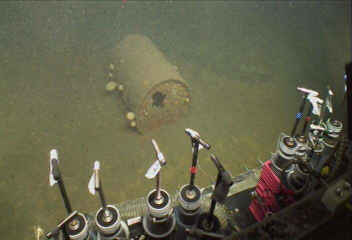
Et ainsi, nous pouvons voir la vidéo sur un écran du fond marin réel, mais nous pouvons également voir la carte, le radar orienté vers l'avant et nous pouvons dire mon Dieu “ ils arrivent, ils arrivent. ” Et puis, soudainement, du fond de la mer surgissent tous ces, vous savez, fûts métalliques de 55 gallons qui sont dans une variété – vous savez, qui fuient des trucs et enterrés, et vous savez, c'était, vous savez, un de ces moments de la vie ; “ oh mon Dieu. ”
Ce n'était pas prévu ! Nous sommes sortis pour récupérer du pétrole au fond des océans. Et, vous savez, ce qui se passe ensuite, c'est deux choses qui se sont produites 50 fois dans ma carrière. La première partie, c'est que j'ai parlé à Dave, qui se tient à côté de moi. C'est le scientifique en chef. Et je me dis : “ Dave, nous devons prélever autant d'échantillons que possible ”, parce que nous n'avions pas beaucoup de temps, car cela ne faisait pas partie de la mission. Mais nous nous sommes dit : “ nous devons prélever autant d'échantillons que possible ”. Nous avons donc dû faire un détour, poser Jason au sol, utiliser ce bras robotique.
Voilà pour la première partie de l’histoire de Chris et Bob. La deuxième partie, c’est moi qui appelle Bob ou qui lui envoie un e-mail en lui disant : “ Tu vas te préparer. On va envoyer ça. Je vais poster ces échantillons dès qu’on sera descendus du bateau, parce qu’ils sont vraiment incroyables. ” Et c’est exactement ce qui s’est passé. Tu sais, on peut parler davantage de ce qu’on a trouvé. Le plus mémorable, le plus génial, c’est qu’on a eu la chance de disposer, dès le départ, du même type d’instruments d’analyse pour trouver les échantillons que pour les analyser avec une plateforme LECO. On a donc pu s’appuyer sur une technologie de pointe.
Julie : Ouais, c'est incroyable. Parce que, ouais, comment d'autre pourrais-tu arriver à voir ce qu'il y a sur le fond marin avec toute cette pression ?
Chris : Et en plus de ça, on avait le gars sur le bateau. C'est un ingénieur. Si vous perdiez quelque chose dans l'océan, c'est lui qui le retrouve. En fait, à toutes fins pratiques, c'est lui qui a trouvé le Titanic. Donc c'était – nous avions de bonnes personnes, la bonne technologie, au bon moment et au bon endroit. Et nous avons fait cette trouvaille incroyable.
Julie : On dirait que, ouais, c'était vraiment le bon endroit au bon moment.
Chris : Ouais, sans aucun doute. Mais, tu sais, à certains égards quand même, pour rendre justice à notre pote Dave Valentine, c'est un type curieux et il avait lu des trucs là-dessus. Et, tu sais, il s'est dit : “ hé, on a un petit trou dans notre planning. On devrait aller jeter un œil. ” Tu sais, beaucoup d'autres scientifiques principaux n'auraient peut-être pas voulu quitter le site et tout le bazar. Il a aussi su mobiliser toute l'équipe pour le faire, donc il y a aussi beaucoup de super leadership là-dedans.
Donc les échantillons ont été prélevés avec un, genre, pensez-y comme à un tuyau – un tuyau transparent comme on en trouve chez Home Depot – et le robot enfonce le tuyau dans le sol puis le remonte, et maintenant vous avez un tuyau de quatre pouces de diamètre avec, vous savez, probablement – je ne sais pas – 12 ou 14 pouces de boue collectée. Et cette boue, au fond des fonds marins, c'est un peu comme les cernes d'un arbre, vous savez, plus la boue est profonde, plus elle est ancienne, n'est-ce pas ?
Et généralement, nous traitons les échantillons sur le pont. Donc le bateau arrive, nous prenons la carotte, nous prenons en fait une sorte de – imaginez cela comme un piston. Nous poussons le matériau par le bas et les petits gâteaux de boue sortent. Et puis, vous savez, nous le tranchons littéralement avec un couteau de cuisine et on se retrouve avec des palets mesurant parfois de un à deux centimètres, que l'on met dans un bocal.
Vous avez donc maintenant des échantillons discontinus prélevés à un seul endroit, vous savez, à peut-être quatre ou cinq profondeurs, que nous pouvons, que nous pouvons aussi réellement dater, en disant : “ oh, cela date d'environ 1965, 1975. ” Ceux-ci vont dans un bocal et sont échantillonnés sur le pont. J'ai fait partie de l'équipe d'échantillonnage, en fait. J'étais à fond là-dedans. Et puis nous le mettons dans un bocal et il est congelé. Et puis, vous savez, nous les avons expédiés directement à Bob une fois que nous sommes descendus du bateau.
Et nous avons fini par y retourner en 2013. Le premier article n'a pas été publié en 2019 pour diverses raisons : le temps, l'argent, bla-bla-bla. Mais les échantillons sont revenus, et vos deux questions suivantes portent plutôt sur l'analyse. Mon travail s'arrête, vous savez, j'écris juste un e-mail, le bocal et l'échantillon vont à Bob et je dis : “ Bob, fabriquons-en, raconte-nous une histoire. ”
Julie : Alors c'est toi, tu es l'homme aux commandes maintenant, hein, Bob ?
Bob : Ah ouais, c'est clair.
Pourquoi le WHOI utilise l'analyse GCxGC [17:27]
Julie : Très bien, cela mène donc à la question suivante. D'un point de vue analytique, quels sont les plus grands défis que vous avez rencontrés dans le projet et comment y avez-vous répondu ?
Bob : Le défi, c'est que c'est un total inconnu. Je veux dire, on se doutait qu'il y avait des pesticides. On aime ratisser très, très large, c'est pourquoi on utilise la plateforme GCxGC. Parce qu'il s'avère que, vous savez, il y avait des composés ciblés — on avait effectivement quelques composés ciblés, mais on ne savait pas non plus ce qu'il y avait d'autre là-dedans.
Il s'agit donc généralement et presque toujours d'une approche non ciblée que nous adoptons parce que nous aimons voir autant que possible, c'est pourquoi nous utilisons des gradients très longs et très lents. Nous utilisons une colonne de première dimension très longue, et cetera. Le défi, vous savez, le défi est donc le suivant : qu'est-ce que c'est que ça ? Et comment faire, comment découvrir ce qui s'y trouve ?
Chris : Nous ne savions pas non plus ce qu'il y avait dedans.
Bob : Il y avait des déchets médicaux et potentiellement dans certains, vous savez, il y avait—
Chris : Du matériel radioactif a été trouvé dans certains de ces objets. Donc, vous savez, il y a un certain sentiment d'incertitude. Il faut prendre beaucoup — il faut faire très attention.
Bob : “Apportons-nous des explosifs ?”
Chris : Ouais, tout à fait possible. Tout tout à fait possible.
But we expected to see DDT and those types of chemicals because they were downstream from one of the biggest manufacturers of DDT in the United States, Montrose. But another one that has happened a thousand times between Bob and me is that: I know Bob’s running the sample and then I wait like an hour so I don’t annoy him. And then I go, “what’s it look like?”, right?
And, you know: a watched chromatograph does not separate.
We’re looking at it together and you go, “there’s a lot more oil in this.” The DDT gets the top billing, but most of the chemical in those extracts that were analyzed by LECO, are petroleum hydrocarbons.
It’s not–it’s just that DDT… Rachel Carson wrote about DDT. She didn’t write about oil. And that’s not surprising since–if you’ve ever been on The 5 in the Los Angeles area–there’s all these oil refineries. So it doesn’t surprise at all, that kind of makes sense.
Résultats inattendus en GCxGC : Composés du DDT [20:02]
Julie : That kind of leads into my next question, which was, if you could share an example of something unexpected that GCxGC revealed in your samples.
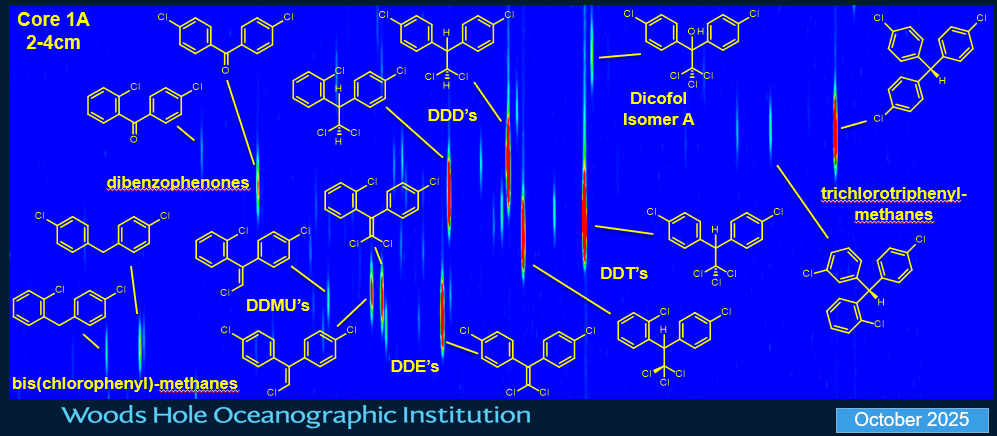
Bob : Sure. So we did find all kinds of petroleum biomarkers, like the hopanoids and steranes and compounds like that. We also found these linear alkylated benzene detergents that–I actually first saw those from a colleague of ours from our department back in the early 1990s. He was looking at Deep Water Dump Site 106 off of New York, and he found all these industrial detergents.
And we saw some of those in the sediment cores. We also saw in some of the later cores that were not in that paper, we actually found compounds that contain nitrogen, anilines—which we are assuming now that are one of the starting compounds for DDT–the DDT synthesis process. It’s a potpourri of all kinds of interesting things that we weren’t expecting to see.
Chris : Yeah, I mean, and this is where the LECO platforms come in, in that: if these samples–and they were–analyzed by 1D, GC-FID and GC-MS, you would get some interesting outcomes. You would have seen the DDT and stuff like that.
But you have to remember that when Montrose sold their product when they sold DDT to everybody, right, it wasn’t just one single molecule. It wasn’t just DDT. Like, if you buy an individual chemical from Aldrich, when you buy a chemical, you expect to get it to be 99% or something like that. But the DDT that was released and used as a pesticide in the United States was what we would call “technical grade,” and it was about 60% DDT. The rest of the 35% or so was a variety of different byproducts, incomplete products, and a range of other chemicals. So when we talk about DDT, it’s not a single entity. It’s the outcome of this reaction where they didn’t do a good job cleaning it up.
Plus, that waste might have had stuff that was left over in some reaction, it could have been otherwise. The end result, I can’t remember the number was, is that any self-respecting chemist with a benchtop GC-MS could have identified DDT, and there’s another compound called DDE, and there’s another one called DDD–totally no problem.
It’s all the rest of these compounds that were associated with DDT, that that’s where we were able to pluck them out of these complex mixtures with the HRT, with the high-res mass spec. And we went one step further–Bob went one step further. And Bob created in this paper–and this paper is one of my favorite ones of all time because we have “sloppy” in the title. Uh, if you haven’t gotten the paper—
Bob : Do you have it?
Chris : “Chemical dumping was a sloppy process.” It’s free–but we’ll send you the paper–but in the supplemental information, one of the really important points was, is that Bob went and created a library of all the different halogenated, chlorinated compounds related to DDT and put in their high-res mass spec in the back of the–basically the end of the paper, kind of the appendix–and then ranked how he identified them. You know, it’s two parts.
If I was going to list, maybe the top 10 things that, in terms of informative work that I’ve done in my career, those two files, and the supplementary information that’s all about the returns of the GCxGC-HRT are that, those two.
Bob : Basically, it’s a confidence level of how confident are we in our assignments. We show our high-res spectra versus the NIST library spectra as well . So you can compare and contrast what we got versus the NIST. They’re all really good fits actually. Except, for we got four digits past the whole unit resolution. We have a lot more confidence in our assignments because of our ability to use the mass defect that you can’t really use on a regular mass spectrum that only does whole unit resolution.
Julie : Génial.
Chris : And the other thing is that, remember I was talking about the layers, right?
Julie : Yeah.
Chris : What’s interesting is that, we got different GCxGC chromatograms at different depths, right? And so it’s not only that; and the different cores had that. So we’re not only asking the LECO platforms–and they delivered–to tell a story about one singular sample at that dump site. We’re asking it to help us tell a story and interrogate the contents of one core at five or six different horizons, and the contents of another core with five or six different horizons.
So it’s not just tell a story with one sample, it’s tell a story with 10 samples, 20 samples. And that’s when you can start visually comparing and doing all this stuff that’s way beyond me. And that becomes Christina’s problem—your Christina’s problem, not ours—about how do you process that information and to look for similarities and dissimilarities so that you can then use that data to hone in and target more stuff.
Passage au crible des données [25:49]
Julie : Yeah, that perfectly leads into another question I had on here, which was, you did–I mean–all of that data, everything it comes back with, like how were you able to sort through that and come up with some of those conclusions?
Bob : We use, in order, you know, in order to find the chlorinated compounds, I use the RDBE versus carbon number apps , which are great for any compound that has a hetero–a heteroatom–like anything chlorinated, anything brominated, anything with a nitrogen, anything with a sulfur, et cetera.
So that basically let us, let you focus right in on that hot area right away. And that was–in the beginning, that was what everybody wanted to see was, you know: what are the chlorinated compounds, and how many of them are there, and where are they, and et cetera, what do they look like, you know?
Further out we started looking at other compounds: sulfur containing, anything with the nitrogen–and on subsequent cruises we found all these anilines, which we believe are the starting compounds for the chlorinated pesticides.
Chris : I’m not quite–Julie, I’m not sure of how much chemistry background you have and forgive me—So, another reason why the HRT and the accurate mass becomes incredibly powerful in this investigation is exactly what Bob said, which is that: these samples were not just carbon and hydrogen and even chlorine, but they had nitrogen and sulfur and oxygen.
When you start building molecules with these, what we call “heteroatoms,” you end up getting some very interesting compounds that you don’t usually look for. If you had a benchtop GC-MS, you would just have to sit there and get very lucky trying to see if there were any nitrogen-containing compounds. You would almost have to get lucky in some respects.
The way in which the HRT collects data and the way in which how each one of those atoms weighs—
Bob : their unique mass—
Chris : their unique mass, the information that’s encoded in the HRT allows us to actually say, “do any of these things have something that weighs X?” And if it does, it must have a nitrogen in it.
And that’s how Bob was interrogating these samples for these heteroatoms, which are very hard otherwise. Because the data afforded by the HRT was so–had such great resolution–there was so much information encoded in it that we could interrogate it and ask it for: where are all the nitrogens, where are all the oxygens, and where are all the sulfurs?
And one thing to keep in mind is that it’s often just as important–not as much fun–to show that something is not there as is there. And then Bob can look for something and say: I wonder if there’s any of these XXY compounds? If they were, then they should weigh 192.6754.
Bob can put that number in and scan, and if it’s not in the sample, it’s not there. That is incredibly powerful. So it’s not just finding with confidence, it’s also showing it’s not there with confidence. And that is where the HRT also excels.
Julie : Wonderful. I learned something new today. Yeah, being able to look specifically and interrogate the data like that–that’s something that’s really insightful, something that I didn’t even know our instruments could do.
Chris : I’m not sure where this is, and it wasn’t necessarily your question, is that–we think, and we don’t think there’s any doubt—we’re not industry shills or anything like that. We’re not paid by LECO, right, to do anything.
But we strongly believe that this industry (you are industry)/academic connection, and the fact that we have such fruitful exchanges, you know, that puts us at a competitive advantage with our colleagues, right?
Bob : And we actually consider LECO colleagues.
Chris : You know, are very nice and i think that’s you know part of you know if you wanted to look at LECO special sauce right it is that it’s a family business, you know—is it still a family business?
Julie : Yep.
Chris : Yeah, I mean, you can feel that. It’s not—it’s undeniable, absolutely. Because we get a ham, and we eat the ham, you know. I’ve given the ham away to Goodwill, too. I mean it’s great.
Julie : Oh yeah
Chris : It’s a very nice touch.
Julie : Yeah, they do that. I think it’s employees get turkeys around Christmas and stuff.
Chris : They don’t ship well, but the hams do.
Julie : [laughing] Exactly.
Chris : Thank god for salt.
Julie : Right, right, exactly. So, yeah, it is something cool that they do. I’m so glad to see that they do that for you guys, too. That’s so neat.
Chris : They wouldn’t have to, right?
Julie : Right. I feel like you guys kind of answered. You know, we talked about what makes GC by GC pivotal for the environmental analyses, which is being able to take a deep dive into the data, interrogate it, find what’s not there or what is there, right?
Chris : Yeah
Julie : Kind of the being able to explore the unknowns.
Chris : Yeah. And you know, where this becomes powerful moving forward is that, let’s all be honest–and I don’t want Joe to kill me–every lab in the country, the world, is not going to get a LECO platform–you probably don’t want to have every lab.
But where this becomes super powerful—and this is where LECO acts–the GCxGC platforms by LECO—they act like a guiding light for how this country decides what to look for in the future. And so we can see it with LECO. We can communicate what we see and we can start to give advice about like: look–and others can too–all right, you don’t have a LECO platform. But, if we did this, this, this, and this, and four jumping jacks, we could do it with a benchtop GC-MS.
And if they did this and did this, they could do it—
Bob : As long as they know what they’re looking for—
Chris : As long as they know what they’re looking for. And so maybe, the GCxGC is actually in some respects paving the way for more traditional, less advanced platforms to provide society with information.
That is very powerful. It’s very powerful that we can find, communicate and elaborate and tell the story because it’s more than just saying it’s there. It’s: why is it there? Where did it come from? How long has it been there? And when you start to build those stories, then folks can make the policy decision and other decisions about whether or not they need to be investigated at a greater level and thinking about how they can make it more… studied.
But you can make breakthroughs by looking at GCxGC data, and saying: look at this peak and what is it? And then say: where did it come from? And what did it look like? Is it what came out of the tailpipe of this car or did nature slightly modify it? And then did nature modify it again?
Sometimes we can see the original chemical. We can see it’s getting modified once, maybe by sunlight. We can see it getting modified again by microbes. Those stories are all in the GCxGC chromatograms.
Bob : And a lot of times those peaks are in the weeds for people on a traditional one-dimensional gas chromatograph.
Chris : Yeah. Think about traditional GC—and I love traditional GC; I was just showing Bob some GC-FID chromatograms—traditional GCs are very good at looking at redwood trees in a chromatogram.
LECO can see the redwood tree, the smaller pine tree, the bush,
Bob : and the grass
Chris : the grass, and then some little critter that’s living on the grass. And while it might not be abundant, it’s informative. And that’s the trick, right, is that we’re putting a microscope on these samples and not being obscured by the big stuff.
Julie : I think that’s an excellent way to put it.
Investigations plus approfondies sur les polluants environnementaux [34:29]
Julie : You started to touch on this a little bit, but how might the research that you guys are doing inform other investigations into environmental transformation of pollutants, like PFAS or microplastics?
Chris : Yeah, I mean–you know, we make a significant effort to publish our work, and that matters a lot to us. And we make a significant effort to communicate about our results, whether it’s seminars like next month and things like that. That’s where our job is. We get out there, and we tell these stories, and we tell them where we think this is important.
And, you know, whether–we’ve been looking at compounds associated with plastics for years as well. Our job–we don’t look at millions of samples. We look at enough samples for us to tell a story and hopefully help others pave the way for more comprehensive, bigger projects. We’re not–we’re a small team–but we bang the drum and our drum is a LECO instrument.
Julie : I love the way you put that. I think I just have a couple questions left for you guys. Are there encouraging trends or new strategies emerging for the remediation of persistent organic pollutants in the environment?
Chris : You know, it’s tricky. We spend most of our time in the ocean. And, Mother Nature is a fickle beast. And, trying to do cleanups and things like that are really, really hard.
Bob : Especially at 900 meters.
Chris : Yeah, but here’s where you have to make a decision.
There’s decisions when you have a polluted area. And the decision is, do you leave it alone or do you bring in the bulldozers? And a lot of times people will say, “we got to take it away. We have to get rid of this. We have to clean up the area.”
But, those things come with costs, right? I mean, if you have this pristine salt marsh and you bring in bulldozers to take out one contaminated spot, what’s the net benefit, right? And so ultimately when they’re making decisions about cleaning up, or where to clean up, or where to protect when there’s an event, right? Like: look, we have two boats and there’s three areas that we’re worried about.
You want to make the most well-informed decision, and you make your most well-informed decisions, and you make your best Net Environmental Benefit Analysis when you have well-characterized samples. And that’s where the platforms come in.
Bob : So the question is–for me, the question is: are these compounds sequestered or are they available to the environment? And, you know, over time more sediments come down and pile up on top of them. So, are they actually going to be available to be re-suspended in the water column and come back up? Or, is it better off to let the sedimentation of compounds basically bury them and sequester them at the seafloor?
Chris : That’s the point, right—is that anytime you have to make a decision about to clean up or not to clean up–environmental benefit, basically––what are the pros and the cons? You know, just like balancing your checkbook, you want to have as much information as possible so that you get the best results, right? The best possible result.
And that’s in our world where we can make a difference is by providing the best characterization.
I can’t think of an example, but it’s entirely possible that you can analyze a sample with traditional EPA methods and it may come back as not particularly toxic, or potentially toxic. But you could analyze it on the GCxGC, find something very unusual that was non-targeted, do a little bit of investigating and saying, well, ‘this isn’t necessarily clean.’ It might be clean per se. “Clean” means that it has non-detects because they only looked for 100 compounds.
But suddenly your chromatogram is dominated with peaks that would have been overlooked otherwise. And now you have a very different story.
But, nature remediates, right? And we follow that all the time. You know, we have done multiple experiments where you might add some oil in a jug, you return to the same spot that’s been oiled, and you watch it change with time. This often happens with microbes. So Bob has tracked microbial degradation many times, but that’s in nature, right? Like, letting nature follow its story.
But the analogs for if somebody was trying to design an experiment maybe in groundwater are right there.
Bob : One of the salient questions that we had at the video–oh, Out of Plain Sight—
Chris : Oh, yeah, the movie on the DDT site, Out of Plain Sight, yeah.
Bob : One of the salient questions was: have you ever actually sampled anything from the barrel?
And the [answer] is no, because we didn’t want to actually release anything. We did sample around barrels that were leaking on the seafloor where you could actually see visual leak patterns from the barrels
Julie : Yeah, that’s actually a really interesting point that you brought up and when it comes to remediation and having to explore all these things, how much you don’t want to disturb, but you also need to be able to discover. So it seems like there’s kind of a balance.
Chris : There’s very much a balance in what they call Net Environmental Benefit Analysis. That very rarely is it an easy decision.
Bob : We don’t want to make it worse.
Chris : Yeah, you don’t want to make it worse, right? And there’s another saying called “no blood for money and no oil for blood”. So you also don’t want to put anybody in harm’s way.
Julie : Sure.
Chris : And so these are the types of things that people are sitting–it’s not us–we don’t we don’t make policy.
You just try to give good science so that the most well-informed decisions are made.
Julie : All right, guys. Last question for you.
Insights to the Élimination bâclée Webinaire [40:38]
Julie : You’re going to be presenting your work in an upcoming webinar with us. What can attendees expect to learn from the event?
Chris : I think, in my mind, is that they’re going to get a story from the beginning to the end of historical pollution of DDT. They’re going to get a story from A-to-Z–and I don’t know how to pack it, you can use better words than I just said–we’re telling the crispest, most resolved story because of the GC platforms. Go ahead, Bob.
Bob : Yeah, I think–I guess the take-home message from us is that there’s always something interesting in the non-targeted analysis. For us, we like to do a more holistic approach rather than just target a few compounds. So the take-home message is: there’s more than just DDT.
Chris : Yeah, and to be honest with you, you know, scientists are always famous for three things: saying we wish we had more time, and more money, because there’s way more in these samples that we just haven’t had a chance–we are busy; funding has always been tight–but there’s a lot left on the table. But it’s not just not the Chris and Bob show.
There’s some other really great—[end]
Learn more about the Sloppy Disposal

Analyse des déchets issus de la fabrication du DDT par GCxGC-HRT
Analyzing the effects of leaching from illegal offshore waste dumps
À la demande


 English
  Spanish
  German
  French
  Portuguese