
Published on
Oxygen and Nitrogen in Lithium-Based Anodes and Battery Materials

Graphite and carbon-based materials form the backbone of most lithium-ion battery anodes. Their purity and composition are paramount, and the amounts of oxygen or nitrogen present can dramatically affect a battery’s capacity, lifespan, and safety. In this piece, we explore why oxygen and nitrogen content are important to battery materials analysis, and how efficient, precise measurements enable battery innovators and manufacturers to push the limits of performance and reliability.
Why Oxygen and Nitrogen Matter
Carbon anodes need to be ultra-pure and consistent in order to ensure quality. Oxygen is often introduced unintentionally during material processing or storage as surface oxides or moisture in graphite. Even at low levels, oxygen content can alter how lithium ions intercalate into the carbon structure of the anode and can undermine the graphite’s structural stability.
Simply put, too much oxygen in an anode can reduce a battery’s energy density and shorten its cycle life. High oxygen content causes a graphite anode to hold less lithium and can lead to excessive solid-electrolyte interphase (SEI) formation or gas generation, which over time hurts performance and safety.
Nitrogen, on the other hand, is a bit of a double-edged sword. Battery researchers sometimes intentionally dope carbon with nitrogen to boost electrical conductivity. The right amount of nitrogen in graphite can enhance electron transport and even improve lithium-ion intercalation kinetics, ultimately improving the battery’s power and lifespan. However, doping must be carefully controlled. Too little nitrogen limits performance gains, while excessive nitrogen can introduce unwanted structural defects or variability.
If nitrogen finds its way into materials unintentionally (like as a contaminant from manufacturing processes or feedstocks), this could also lead to inconsistent performance. Both oxygen and nitrogen, whether added by design or present as impurities, need to be carefully managed to ensure the battery delivers optimal performance and remains safe throughout its life.
TOC Measurements
Imperative from Research to Production
Managing oxygen and nitrogen begins with accurate measurement. Battery Research & Development (R&D) teams rely on oxygen and nitrogen (O/N) analysis to understand how new material formulations behave. In production, consistent quality is everything. Routine oxygen and nitrogen testing is now a staple of battery material quality control as manufacturers use these tests to qualify incoming raw materials and to monitor each batch of finished anode powder for compliance with specs.
Accurate O/N data also helps engineers tweak process parameters to hit the desired purity or doping levels. The payoff is enhanced process optimization and fewer surprises— batteries meet their performance targets more consistently, with less risk of early capacity fade or safety issues. In short, measuring oxygen and nitrogen enables confidence at every step.
The ON836 Solution
Reliable O/N Analysis for Battery Materials
The LECO ON836 is a robust instrument designed to handle specialized tasks like analyzing oxygen and nitrogen levels in carbon materials. This reliable instrument uses the time-proven method of inert gas fusion with advanced detection systems to measure both oxygen and nitrogen simultaneously in a single run.
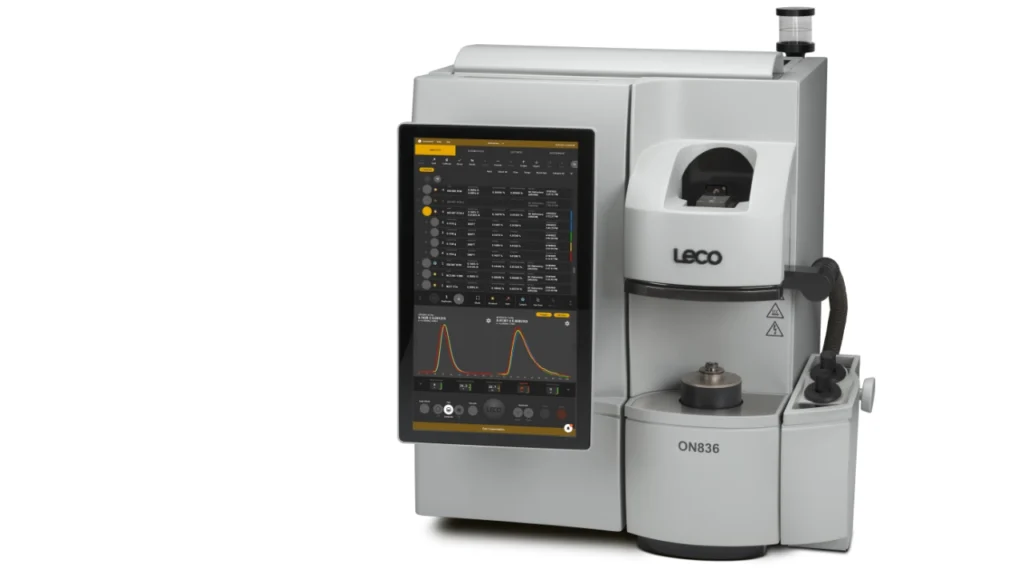
The ON836 is able to quantify each element with sensitive infrared and thermal conductivity detectors, providing precise readings for oxygen and nitrogen levels in just minutes. Plus, a bonus for the battery industry, the ON836 is built to handle the wide dynamic range of O/N content found in carbon materials. Whether you’re checking ultra-purified graphite or a heavily nitrogen-doped carbon prototype, the instrument can accurately measure from low parts-per-million impurity levels to higher intentionally doped concentration levels—all without needing separate tests.
For battery manufacturers and researchers alike, this capability translates into both efficiency and confidence. One analysis on the ON836 yields all the critical O/N data needed for a given sample, accelerating workflows and mitigating bottlenecks. Its ease of use and automation-ready design also mean high throughput for busy labs—a crucial factor as the battery industry scales up to meet global demand. By delivering fast, reliable O/N measurements for every sample, the ON836 helps ensure that each batch of carbon anode material is optimized for performance, consistency, and safety.
Enabling Innovation, Consistency, and Trust
Measuring and controlling oxygen and nitrogen in lithium-based anodes and battery materials is critical to battery performance, longevity, and safety. With advanced solutions like the ON836, battery manufacturers and researchers can confidently characterize materials, optimize processes, and deliver more reliable, longer-lasting energy storage systems.
Expand your Knowledge
If you’re interested in learning more about what LECO has to offer for analyzing battery materials and more, visiting our Battery Analysis Resource Hub.

Integrated Characterization Solutions for Advanced Battery Materials
Combining elemental, thermal, and microstructural analysis catches small material defects early, protecting battery performance and preventing costly failures.
On Demand




 English
  Spanish
  German
  French
  Portuguese