
Published on
Superalloys and Sulfur: Even Trace Amounts Can Be Detrimental

Alloys are formed when a metal is combined with another element to strengthen the base metal’s properties. Basically, an alloy is just a modified metal. Superalloys are similar, but these specific high-performance materials are held to a higher standard. They are typically nickel-based, cobalt-based, titanium-based, or iron-based.
To be classified as a superalloy, the alloy must be able to reliably function under extremely high temperatures, possess superior strength and surface stability, and must be resistant to thermal creep deformation. Strong corrosion and oxidation resistance are also features of superalloys, but it’s important to note that they are not impervious to oxidation over time if protective measures are not taken. Unfortunately, even when protective measures are taken, contaminants like sulfur threaten to render that protection useless.
Why is Protection from Oxidation Important?
Oxidation negatively affects a superalloy by weakening its strength, which over time can lead to embrittlement and cracking. Since high-performance materials like superalloys are mainly used and relied on in industries like aerospace and nuclear energy, it is crucial that these materials perform as intended. Material failures could be the difference between life and death, in some circumstances.
Controlling Oxidation with Selective Oxidation
To make superalloys even more indestructible and shield against oxidation, selective oxidation is performed. With selective oxidation, superalloys are designed to oxidize in a way that creates a protective layer of oxidized material that “covers” the alloy, keeping the alloy’s inner structure from oxygen invasion. However, this means that in order to keep protecting the superalloy’s infrastructure, the protective oxidized layer needs to remain stable and intact.
Sulfur: A Dangerous Threat
The presence of sulfur, even at trace levels, can interfere with the selective oxidation process. Sulfur degrades that protective layer, leaving the superalloy vulnerable to negative oxidation and shortening its useful lifespan. Therefore, the accurate determination of sulfur content, down to the tenth of a microgram, is paramount for ensuring optimal performance and longevity in superalloys.
A Combustion Technique for Ultimate Confidence
Historically, the only way to accurately determine ultra-low levels of sulfur was with glow discharge mass spectrometry (GD-MS), due to its high sensitivity. Now, even combustion methods can be used when paired with the right instruments, like LECO’s CS844ES.
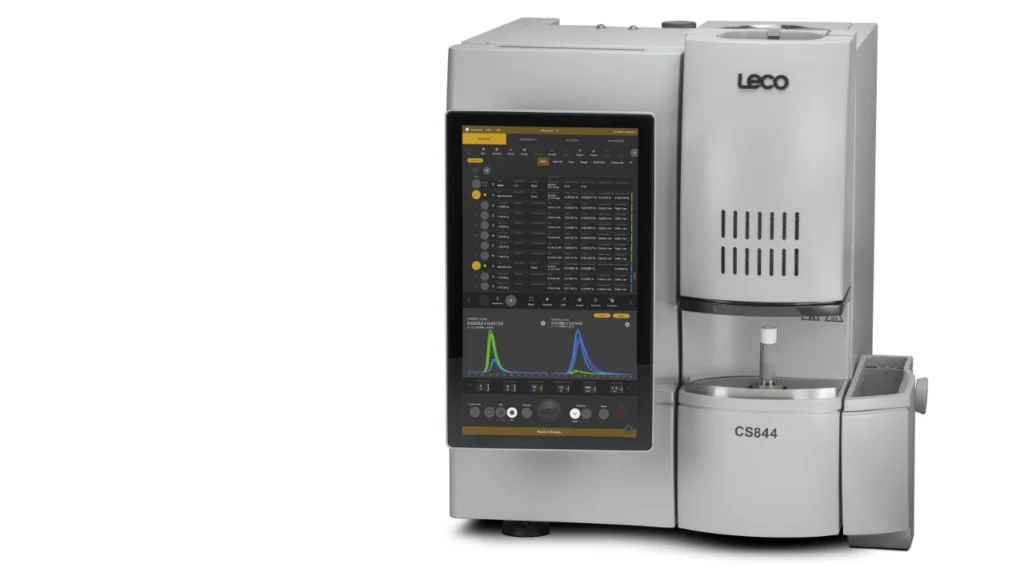
The CS844ES uses high-frequency combustion and intelligent carrier gas management with infrared detection to reach a detection limit of approximately 0.1μg, guaranteeing even trace amounts of sulfur will be detected and ensuring confident quality control of superalloys. The sensitivity, ease-of-use, and speed of this instrument make it a reliable tool for any lab. Plus, the cost of combustion instrumentation is significantly lower than GD-MS, making it a practical choice as well.
Learn More about Sulfur and Superalloys
Since superalloys make up fundamental parts of aerospace equipment, medical devices, and more, knowing that they will perform as they are supposed to is paramount. Feeling confident in sulfur level results can be achieved through specialized combustion techniques, avoiding costly GD-MS.
Determining Ultra-Low Sulfur Levels in Alloys with CS844ES
Ultra-low sulfur content is critical for maintaining oxidation resistance and mechanical performance in high-temperature alloys used in aerospace and other demanding applications. This application note describes how the LECO CS844ES enables accurate determination of sulfur at levels as low as 0.1 µg in steel, nickel, and superalloys, extending the combustion technique to sensitivities previously achievable…
203-821-540
Are you interested in learning more about how LECO supports the high-performance materials industry? Explore our High Performance Materials resource hub for additional application notes and webinars.


 English
  Spanish
  German
  French
  Portuguese